
 English
 Français
 Español
 العربية
 繁体中文
 简体中文


Why Vehicle Data Is Becoming A Compliance Topic
Why Vehicle Data Is Becoming A Compliance Topic
The next compliance audit may ask more about your data than your hardware.
For decades, automotive compliance focused on physical products.
Engineers prepared for:
EMC testing
RF testing
Electrical safety
Environmental testing
If the hardware met the required standards, the project moved forward.
But modern vehicles are no longer defined only by hardware.
They continuously generate, exchange and update data.
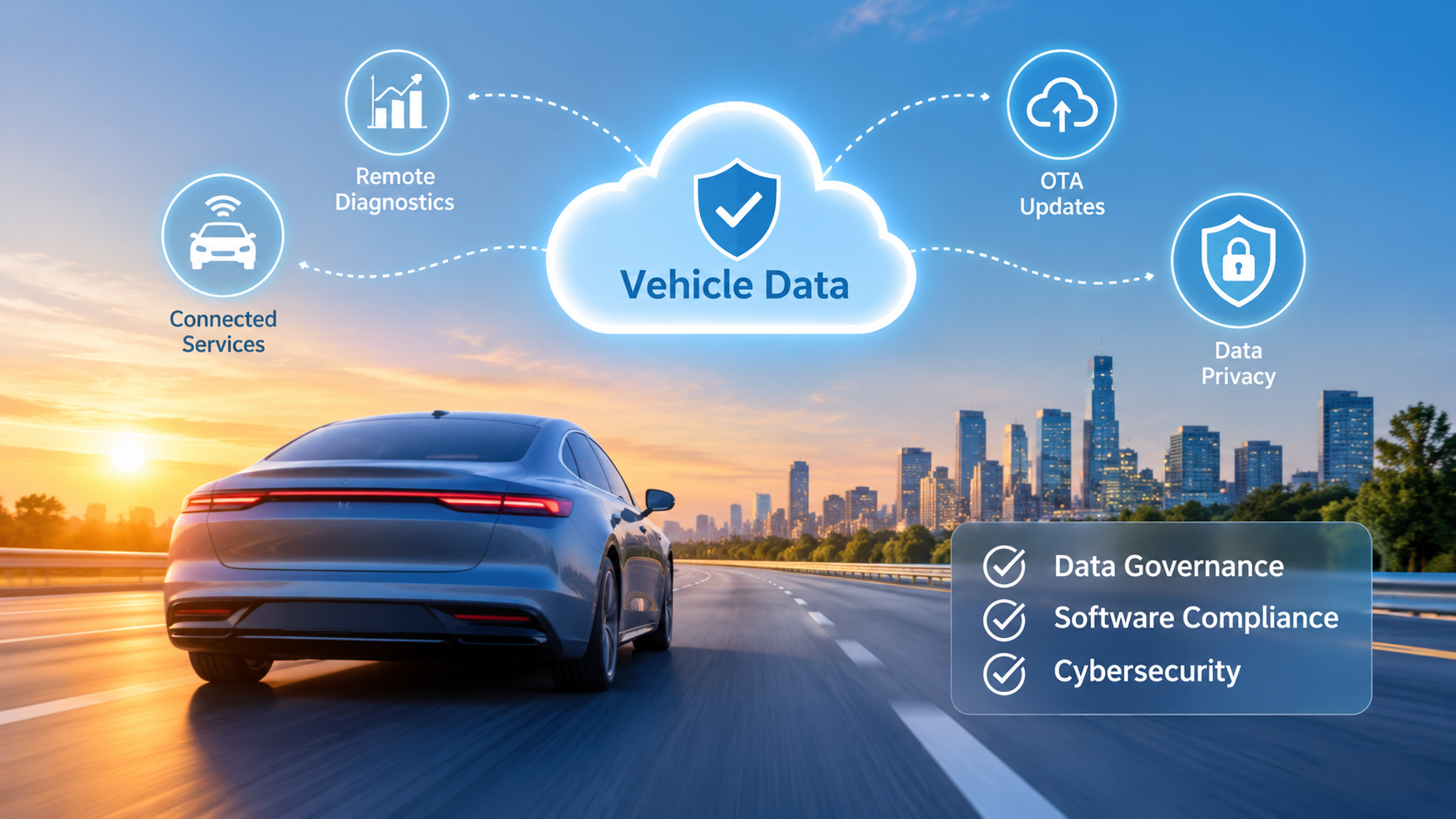
As vehicles become increasingly connected, Vehicle Data is becoming an important part of product compliance—not because data itself is being "certified," but because it increasingly affects how products are designed, maintained and trusted throughout their lifecycle.
Modern vehicles are becoming data platforms
Today's connected vehicles generate information from almost every system.
Examples include:
Remote diagnostics
Navigation services
Battery status
Vehicle health monitoring
Driver assistance systems
OTA software updates
Connected infotainment
Cloud-based services
Much of this information is exchanged between the vehicle, cloud platforms and mobile applications.
As a result, vehicles are becoming data platforms rather than isolated electronic products.
Data now influences compliance decisions
Traditionally, compliance answered questions such as:
Does the radio comply?
Does the product meet EMC limits?
Is the hardware safe?
Increasingly, engineering teams also need to answer questions like:
What vehicle data is collected?
Where is it processed?
How is it protected?
Who can access it?
What happens after a software update?
These questions are becoming more common during OEM assessments, supplier reviews and software governance discussions.
The focus is expanding from product performance to lifecycle management.
Cloud connectivity changes everything
Connected vehicles no longer stop evolving after production.
Cloud services support:
Remote diagnostics
Predictive maintenance
Feature activation
Fleet management
AI improvements
OTA updates
Every new connected service creates additional data flows.
Managing those flows requires engineering teams to think beyond hardware and software functions.
They also need visibility into how data moves through the entire ecosystem.
Data governance is becoming a competitive advantage
A growing number of OEMs now evaluate suppliers not only on product quality, but also on how they manage software and data.
Strong Data Governance helps organizations:
Maintain software traceability
Support configuration management
Improve change control
Strengthen lifecycle management
Respond more efficiently to audits
Good data management is no longer just an IT responsibility.
It is becoming part of automotive engineering.
A recent Deloitte Global Automotive Consumer Study also highlights growing consumer concern about connected vehicle data sharing and privacy, reinforcing why data governance is becoming strategically important for the automotive industry. Deloitte Global Automotive Consumer Study
Compliance is expanding beyond the laboratory
Traditional testing laboratories remain essential.
However, many future compliance activities will also depend on documentation, software processes and lifecycle evidence.
Engineering teams increasingly need to demonstrate:
Software version history
Configuration records
OTA change management
Data management processes
Traceability throughout the product lifecycle
Compliance is becoming a combination of technical validation and operational governance.
Five questions every product team should ask
Before launching a connected vehicle, consider:
✅ What vehicle data does the product collect?
✅ How is that data managed throughout the product lifecycle?
✅ Can software updates be fully traced?
✅ Does your organization have clear data governance processes?
✅ Can you demonstrate compliance after future software changes?
These questions are becoming just as important as traditional hardware validation.
Final Thoughts
The future of Connected Vehicles will not be defined only by smarter electronics.
It will also be defined by smarter data management.
As vehicles become increasingly connected through cloud services, remote diagnostics, AI and OTA updates, compliance is evolving beyond physical hardware.
The organizations that succeed will not simply build reliable vehicles.
They will build reliable systems for managing data, software and continuous change.
Because the next generation of automotive compliance is not only about what your product does.
It is also about how your product manages information throughout its entire lifecycle.
Join the discussion
Do you think future automotive compliance will focus as much on data management as it does on hardware testing?
How is your team preparing for connected vehicle data governance?
I'd love to hear your perspective in the comments.
 ブログ
Bluetooth LE Audio & Auracast: What Manufacturers Need to Know
記事を読む
 ブログ
Wi-Fi 7 Testing: What IoT Manufacturers Need to Know
記事を読む
 ブログ
EU Cyber Resilience Act (CRA): What Manufacturers Need to Know Before 2027
記事を読む
 ブログ
Why Vehicle Data Is Becoming A Compliance Topic
記事を読む
 ブログ
Why NG eCall Certification Starts Long Before the Emergency Call
記事を読む
 ブログ
How Should Smart Cockpits in APEC Official Vehicles Be Validated?
記事を読む
関連サービス

 4000259520