
 English
 Français
 Español
 العربية
 繁体中文
 简体中文


How Should Smart Cockpits in APEC Official Vehicles Be Validated?
How Should Smart Cockpits in APEC Official Vehicles Be Validated?
From HiCar Connectivity to ITU-T Voice Quality
For a premium official vehicle, a smartphone that fails to connect, a voice call with echo, or unstable hands-free audio is not just a technical issue. It can become part of the passenger experience.
In November 2026, Shenzhen entered the APEC spotlight.
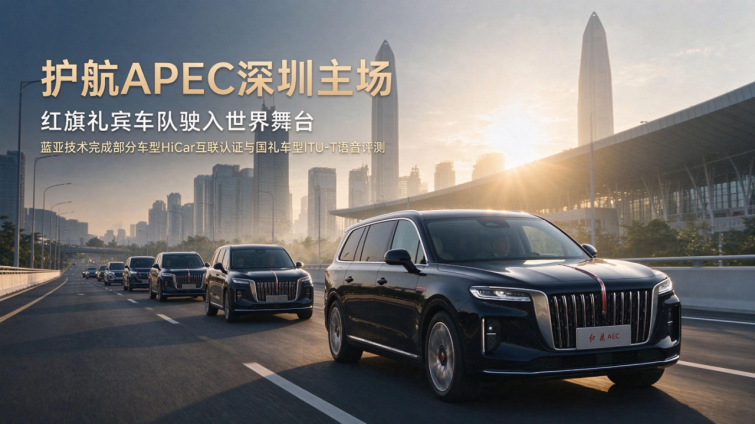
Nearly 700 Hongqi official vehicles were deployed for transportation support during the 33rd APEC Economic Leaders’ Meeting, covering sedans, SUVs and MPVs including the Hongqi H9, HQ9, Tiangong 07, Tiangong 08 and Golden Sunflower models.
For these vehicles, the smart cockpit is more than an entertainment system.
It is a communication interface.
A guest may connect a smartphone through Huawei HiCar, make a hands-free call, use navigation, interact with applications, or communicate with an accompanying team. In this environment, connectivity stability and voice quality become part of the vehicle's overall service experience.
This is where conventional “feature verification” is no longer enough.
1. Why Premium Official Vehicles Require More Than Basic Connectivity Testing
A smart cockpit integrates multiple wireless and audio technologies into one environment:
Bluetooth
Wi-Fi
Cellular communication
GNSS
Smartphone connectivity
Hands-free calling
Vehicle microphones and speakers
Infotainment applications
Vehicle communication interfaces
These systems can interfere with or depend on each other.
A vehicle may successfully complete a basic HiCar connection test in the laboratory but behave differently when multiple wireless devices are active simultaneously.
Typical problems include:
Connectivity instability: device discovery fails, pairing takes too long, connections repeatedly drop, or audio stops after reconnection.
Wireless interference: dense RF activity around large venues, cellular networks and multiple wireless devices can create a more demanding electromagnetic environment.
Voice quality degradation: road noise, HVAC noise, passenger conversation and cabin reflections can reduce hands-free communication quality.
Echo and double-talk problems: insufficient echo cancellation can cause the remote party to hear feedback or distorted speech.
Data-security concerns: smartphone connectivity and vehicle communication interfaces introduce additional attack surfaces that require appropriate access control and data protection measures.
Therefore, a premium cockpit should be validated as an integrated system, not simply as a collection of individual functions.
2. HiCar Testing: The Connection Is Only the Beginning
Huawei HiCar provides a structured interaction between the smartphone and the vehicle infotainment system.
For an automotive manufacturer, the key question is not simply:
“Can the phone connect?”
The more useful question is:
“Does the complete interaction sequence behave correctly under different operating conditions?”
HiCar testing can involve multiple interaction stages, including:
Device discovery
Connection establishment
Authentication and session setup
Application interaction
Audio routing
Screen and status synchronization
Connection recovery
Disconnection and reconnection
Each stage can expose different problems.
For example, a system may connect successfully but fail when switching between applications. Audio may work initially but disappear after a reconnection. A smartphone notification may appear correctly while another interaction state is not synchronized.
For this reason, protocol consistency and interaction-state validation are essential parts of smart cockpit testing.
BlueAsia has supported HiCar testing and certification for selected Hongqi vehicle models, using an authorized Huawei HiCar testing environment and automated test capabilities to verify these interaction behaviours systematically.
3. ITU-T Voice Testing: Why “The Call Works” Is Not Enough
Connectivity alone does not guarantee a good hands-free calling experience.
For premium vehicles, voice communication needs to be evaluated acoustically.
For selected Hongqi Golden Sunflower models, BlueAsia performed in-vehicle hands-free voice quality evaluation based on relevant ITU-T P.1100, P.1110 and P.1120 series methodologies.
The evaluation can cover parameters such as:
Call delay
Sending and receiving loudness
Frequency response
Echo loss
Double-talk performance
Echo suppression
Background noise suppression
TMOS voice quality score
Testing should also consider different vehicle conditions.
Stationary vehicle
The cabin provides a relatively controlled acoustic environment, making it useful for identifying microphone, speaker, DSP and echo-cancellation issues.
Driving vehicle
Road noise, tyre noise, wind noise and vibration introduce additional acoustic challenges.
This difference is critical.
A hands-free system can perform well when the vehicle is stationary but show significant degradation when the vehicle is moving.
Therefore, static and dynamic testing should not be treated as interchangeable.
4. The Hidden Challenge: Acoustic Performance Depends on the Entire Vehicle
Poor voice quality is not always caused by the microphone or DSP algorithm.
The complete acoustic chain matters:
Microphone → AEC/NS/DSP → communication codec → cellular network → remote terminal
On the receiving side:
Remote terminal → codec → vehicle audio system → amplifier → speaker → cabin
Any stage can influence the final user experience.
For example:
Microphone location affects voice pickup.
Cabin geometry affects reflections.
Speaker placement affects acoustic coupling.
HVAC systems create continuous background noise.
Road noise changes with vehicle speed.
AEC performance depends on reference-signal quality.
Network latency can affect conversational interaction.
This is why laboratory equipment alone is not enough.
The test environment must reproduce meaningful vehicle conditions and generate measurable data that engineers can use for troubleshooting.
5. Smart Cockpit Validation Must Connect RF, Audio and Security
One of the biggest mistakes in connected-vehicle development is treating each compliance discipline as an isolated project.
In reality, the systems are interconnected.
Consider a smartphone connected through HiCar while a passenger makes a hands-free call.
The vehicle may simultaneously involve:
Bluetooth/Wi-Fi → infotainment system → audio DSP → microphone/speaker → cellular communication → vehicle network → cybersecurity controls
A change in one area can affect another.
For example, changing an antenna location may improve RF performance but alter the electromagnetic environment around another electronic subsystem.
Changing the infotainment hardware may affect audio routing.
Changing software may alter connection recovery behaviour or application compatibility.
Adding a new wireless function may introduce additional cybersecurity considerations.
This is why advanced smart cockpit validation requires cross-domain engineering capability.
6. GB 44495 Adds Another Layer of Vehicle Cybersecurity Requirements
Connected cockpits also need to be considered from an information-security perspective.
Smartphone connectivity, wireless communication, vehicle networks and external communication interfaces increase the number of potential entry points into the vehicle system.
For applicable vehicle configurations, manufacturers should consider requirements related to:
Access control
Data protection
Communication security
Security monitoring
Abnormal-event handling
Interface protection
Software and system configuration management
The key point is that cybersecurity should not be treated as a final documentation exercise.
It should be considered together with the architecture of the connected cockpit.
7. What Does a Complete Smart Cockpit Validation Strategy Look Like?
For automotive manufacturers and cockpit suppliers, a practical validation framework can be divided into four layers.
Layer 1 — Connectivity
Verify:
HiCar connectivity
Bluetooth behaviour
Wi-Fi performance
Device discovery
Reconnection
Audio routing
Application interaction
Layer 2 — RF and EMC
Verify:
Wireless performance
Antenna integration
Electromagnetic compatibility
Coexistence between wireless functions
Vehicle-level interference risks
Layer 3 — Acoustic Performance
Verify:
Hands-free voice quality
Echo cancellation
Double-talk
Noise suppression
Frequency response
Call delay
TMOS performance
Static and driving conditions
Layer 4 — Cybersecurity
Review:
Access control
Data protection
Communication interfaces
Security monitoring
Abnormal behaviour
Relevant GB 44495 requirements
This approach provides a much more realistic picture of the vehicle's connected-cockpit performance than isolated feature testing.
8. Why Laboratory Capability Matters
For a project involving premium official vehicles, testing is not simply about producing a pass/fail report.
The laboratory must be able to answer a more practical question:
If the vehicle fails, can the test data help engineers identify why?
This requires appropriate equipment, controlled test environments, automated testing platforms and engineers who understand both regulatory requirements and vehicle integration.
BlueAsia has supported selected Hongqi vehicle models with Huawei HiCar connectivity testing and ITU-T in-vehicle hands-free voice quality evaluation.
Our broader automotive testing capabilities cover RF, EMC, Bluetooth, HiCar, CarPlay, Android Auto, eCall, automotive voice quality and vehicle cybersecurity-related services, enabling manufacturers to evaluate multiple connected-cockpit dimensions within a coordinated compliance strategy.
BlueAsia is also a CNAS and CMA recognized laboratory, a Bluetooth SIG BQTF authorized laboratory, and a Huawei HiCar authorized testing laboratory.
Our objective is not simply to identify whether a feature works.
It is to help manufacturers understand how it performs, under which conditions it fails, and what evidence is needed before the vehicle reaches the market.
Final Takeaway
The smart cockpit of an official vehicle is ultimately a communication system.
HiCar determines whether the smartphone and vehicle can work together.
ITU-T voice testing determines whether people can communicate clearly.
RF and EMC testing determine whether the wireless environment remains stable.
Cybersecurity validation determines whether those connections can be trusted.
When these four dimensions are validated together, smart cockpit testing becomes more than a certification exercise.
It becomes a way to protect the real-world user experience.
Building a connected vehicle for global markets?
Talk to BlueAsia Labs about your HiCar, CarPlay, Android Auto, RF, EMC, ITU-T voice quality, eCall and automotive cybersecurity validation strategy.
 ブログ
Bluetooth LE Audio & Auracast: What Manufacturers Need to Know
記事を読む
 ブログ
Wi-Fi 7 Testing: What IoT Manufacturers Need to Know
記事を読む
 ブログ
EU Cyber Resilience Act (CRA): What Manufacturers Need to Know Before 2027
記事を読む
 ブログ
Why Vehicle Data Is Becoming A Compliance Topic
記事を読む
 ブログ
Why NG eCall Certification Starts Long Before the Emergency Call
記事を読む
 ブログ
How Should Smart Cockpits in APEC Official Vehicles Be Validated?
記事を読む
関連サービス

 4000259520