
 English
 Français
 Español
 العربية
 繁体中文
 简体中文


Your UWB Digital Key Passed RF Testing. Is It Ready for Real Vehicle Access?
Your UWB Digital Key Passed RF Testing. Is It Ready for Real Vehicle Access?
Your UWB module passed RF testing.
The BLE connection works.
The smartphone can detect the vehicle.
The UWB ranging function works in the lab.
So why can the complete Digital Key system still fail validation?
Because a Digital Key is not simply a UWB radio product.
It is a connected vehicle access system involving BLE, UWB, smartphone interoperability, secure key management, vehicle ECUs, authentication, ranging and access logic.
This distinction is becoming increasingly important as Digital Key moves from a premium feature toward a broader automotive connectivity ecosystem.
The Car Connectivity Consortium (CCC) certification program now covers BLE and UWB in addition to NFC, including end-to-end interoperability for passive entry and passive start.
So the question for automotive manufacturers should not be:
“Did our UWB module pass RF testing?”
It should be:
“Can the complete Digital Key system reliably and securely provide vehicle access?”
Digital Key Is a Chain, Not a Single Radio
A typical Digital Key architecture looks more like:
Smartphone
↓
BLE Discovery / Authentication
↓
UWB Secure Ranging
↓
Vehicle Digital Key ECU
↓
Gateway / Access Controller
↓
Door / Immobilizer / Start Function
↓
Key Management / Backend
Each layer introduces a different validation question.
A failure anywhere in this chain can result in:
RF PASS → Digital Key FAIL
That is why separating RF compliance from Digital Key interoperability and vehicle-function validation is critical.
1. FCC / CE Approval Does Not Equal Digital Key Certification
Let's start with the most common misunderstanding.
A UWB module may have completed applicable:
FCC requirements
CE / RED requirements
RF testing
EMC testing
That evidence is valuable.
But it primarily demonstrates that the radio meets applicable regulatory requirements under the tested configuration.
It does not automatically prove:
Digital Key protocol compliance
BLE + UWB interoperability
Smartphone compatibility
Secure key handling
Ranging behavior
Passive entry functionality
Passive start functionality
Vehicle ECU integration
End-to-end user experience
CCC explicitly separates its Digital Key certification program from ordinary radio approval, with certification covering interoperability, security and functionality across the Digital Key ecosystem.
So:
RF Approval ≠ Digital Key Certification ≠ Vehicle Function Validation
This is the first distinction engineering teams should put into their compliance plan.
2. BLE and UWB Have Different Jobs
A Digital Key system may use both technologies, but they are not interchangeable.
A simplified sequence can look like:
BLE
Discovery → Communication → Authentication
↓
UWB
Secure Ranging → Position Determination
↓
Vehicle
Access Decision → Unlock / Start
CCC describes its Digital Key architecture as combining BLE communication with UWB secure ranging for location-aware vehicle access.
That means a UWB-only test is not enough.
You need to understand how the BLE and UWB layers interact.
For example:
Can the phone discover the vehicle?
Does authentication complete?
Does UWB ranging start correctly?
Is the correct ranging session established?
Does the vehicle recognize the phone as authorized?
Does the access decision occur within the expected conditions?
A failure in BLE can prevent UWB from ever becoming relevant.
3. Antenna Placement Can Change the Real-World Result
This is where Digital Key becomes very different from testing a standalone RF module.
The module may be unchanged.
But the vehicle installation can change:
RF performance → Ranging behavior → Access reliability
Consider:
UWB Module
↓
RF Path
↓
Antenna
↓
Vehicle Body / Interior
↓
Phone Position
↓
Ranging Result
The antenna location matters.
So do:
Antenna orientation
Antenna enclosure
Vehicle body materials
Cable routing
Grounding
Multiple UWB antennas
BLE antenna placement
Smartphone position
Driver/passenger position
A module-level RF result should therefore not automatically be treated as proof of complete vehicle-level Digital Key performance.
4. The Real Challenge Is Interoperability
A Digital Key is expected to work with real smartphones—not only one engineering phone.
That introduces another layer of validation.
For example:
Phone A + OS Version X
may work perfectly.
But:
Phone B + OS Version Y
may show:
Slow discovery
Failed authentication
Unstable ranging
Delayed unlock
Failed passive entry
Reconnection problems
Unexpected behavior after software updates
CCC's certification program specifically emphasizes end-to-end interoperability across devices and vehicles, rather than simply validating an individual radio component.
For an automotive OEM, this means your test matrix should not be:
“Does UWB work?”
It should be:
“Which phone + OS + vehicle + Digital Key configuration combinations work reliably?”
5. Ranging Accuracy Is Not the Same as RF Pass/Fail
This is another critical distinction.
Traditional RF testing may ask:
Is the frequency correct?
Is the transmit power within limits?
Are unwanted emissions controlled?
Does the device meet applicable RF requirements?
Digital Key adds another question:
Can the system determine whether the authorized smartphone is actually where the vehicle expects it to be?
That is a functional and security question.
The Digital Key system therefore has to consider:
Distance
Position
Entry zone
Start zone
Vehicle side
Smartphone orientation
Ranging stability
Environmental conditions
Multiple-device scenarios
The goal is not simply to transmit a signal.
The goal is to make a secure access decision based on location and authorization.
6. Security Is Part of the Digital Key Architecture
A Digital Key controls access to a physical vehicle.
That makes security fundamentally different from a normal Bluetooth accessory.
The system needs to consider:
Key Storage
↓
Authentication
↓
Secure Communication
↓
Ranging
↓
Authorization
↓
Vehicle Access
CCC describes security and interoperability as core elements of its Digital Key certification program, and its architecture uses secure key handling and UWB ranging to support protected vehicle access.
This is why a Digital Key project should not be treated as only an RF compliance project.
It sits at the intersection of:
Wireless Compliance + Interoperability + Vehicle Electronics + Cybersecurity
7. What Happens When the Vehicle Hardware Changes?
This is a common issue for Tier 1 suppliers.
Suppose your Digital Key has already been validated.
Then the OEM changes:
UWB antenna
BLE antenna
UWB module
BLE chipset
Gateway
Door ECU
Immobilizer ECU
Firmware
Vehicle platform
Smartphone compatibility matrix
Does the original evidence remain valid?
Do not automatically assume yes—or no.
Instead, perform a configuration impact assessment.
Ask:
What changed?
↓
Which Digital Key function is affected?
↓
Which test evidence depended on that configuration?
↓
Is supplementary validation sufficient?
↓
Is full interoperability testing required?
This approach prevents both unnecessary retesting and unsupported assumptions about evidence reuse.
8. Build a Digital Key Compliance Evidence Matrix
For automotive OEMs and suppliers, I recommend separating the evidence into four layers:
| Evidence Layer | Main Question |
|---|---|
| RF Compliance | Does the UWB/BLE hardware meet applicable radio requirements? |
| Digital Key Certification | Does the implementation meet the applicable CCC Digital Key requirements? |
| Interoperability | Does it work across supported phones, OS versions and vehicle configurations? |
| Vehicle Function | Does the complete system reliably unlock/start the intended vehicle? |
Then connect each layer to the exact configuration:
UWB Module → BLE Module → Antenna → Firmware → Digital Key Version → Phone/OS → Vehicle ECU → Gateway → Vehicle Platform
This becomes your Digital Key Compliance Configuration Baseline.
9. A Practical Pre-Validation Checklist
Before sending a Digital Key system for final certification or vehicle validation, I would ask:
1. Has the UWB module been tested for the target market?
2. Has the BLE layer been validated together with UWB?
3. Is the final vehicle antenna configuration fixed?
4. Has the actual vehicle installation been evaluated?
5. Which smartphone models and OS versions are supported?
6. Has passive entry been validated?
7. Has passive start been validated?
8. What happens when the phone battery is low?
9. What happens when multiple authorized devices are present?
10. What changes after a Digital Key firmware or software update?
11. Which security and key-management evidence is required?
12. Which evidence belongs to the module—and which belongs to the complete vehicle?
If these questions are unanswered, the project is probably not ready for final validation.
Digital Key Is Becoming a Vehicle Compliance Problem
The automotive industry is moving from:
Physical Key
to
BLE
to
BLE + UWB
to
Digital Key + Cloud + Smartphone + Secure Vehicle Access
The technology is becoming more sophisticated.
And the compliance architecture is becoming more layered.
The mistake is to treat Digital Key as:
“Just another UWB product.”
It isn't.
The real system is:
Phone → BLE → UWB → ECU → Gateway → Vehicle Access → Security
Every interface needs to be understood.
How BlueAsia Can Support Digital Key Projects
At BlueAsia Labs, our capabilities across RF, EMC, Bluetooth, Wi-Fi, automotive electronics and connectivity validation allow us to look at Digital Key projects beyond a single wireless test report.
For automotive OEMs, Tier 1 suppliers, smart access suppliers and connected-vehicle electronics manufacturers, we can support:
UWB / BLE RF validation
Automotive EMC assessment
Bluetooth testing
Wireless coexistence assessment
Antenna and RF configuration review
Vehicle-level connectivity validation
Digital Key configuration review
Compliance evidence mapping
Pre-certification risk identification
Global market compliance planning
The objective is not simply to answer:
“Did the UWB module pass?”
It is to answer:
“Can the complete Digital Key system deliver reliable, secure and repeatable vehicle access—and can we prove it with the right evidence?”
RF approval gets the hardware into the vehicle.
Digital Key interoperability makes the system work.
Vehicle-level validation makes it ready for the real world.
If your next automotive project includes UWB Digital Key, BLE, passive entry or passive start, review the complete compliance architecture before final certification.
 ブログ
Why Future Vehicle Certification Will Depend On Digital Traceability
記事を読む
 ブログ
Why SASO 2938 Is Becoming a Software Validation Project
記事を読む
 ブログ
SASO 2938 vs GSO 2693: What the 2026 GCC DAB+ Requirements Mean for In-Vehicle Radio Receive
記事を読む
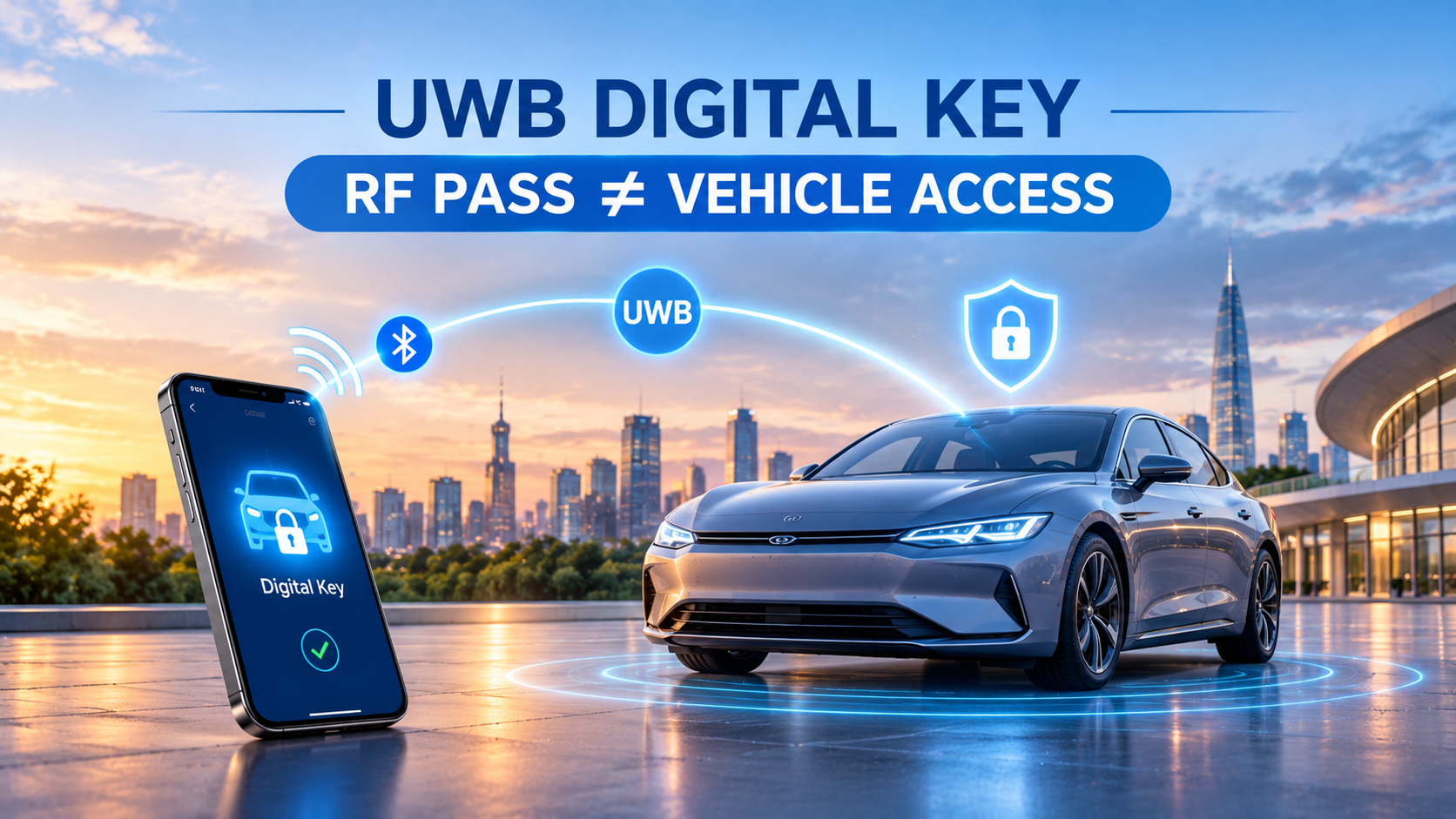 ブログ
Your UWB Digital Key Passed RF Testing. Is It Ready for Real Vehicle Access?
記事を読む
 ブログ
FCC Equipment Authorization: Key Inputs to Prepare Before Testing
記事を読む
 ブログ
Preparing Project Information and Responsibilities for an MFi Program
記事を読む
関連サービス

 4000259520