
 English
 Français
 Español
 العربية
 繁体中文
 简体中文


Your Motorcycle Has Bluetooth, Wi-Fi and a Connected Display. Is It Ready for UN R155?
Your Motorcycle Has Bluetooth, Wi-Fi and a Connected Display. Is It Ready for UN R155?
“R155 is for cars. Does it really affect motorcycles?”
I hear this question more often as motorcycles become connected vehicles.
The answer is increasingly clear: connected two-wheelers can no longer be treated as simple mechanical products with a Bluetooth accessory attached.
UNECE decided in 2024 to extend the scope of UN Regulation No. 155 to motorcycles, scooters and certain other L-category vehicles, recognizing that advanced connectivity, electronic control and assistance systems are creating new cybersecurity risks.
At EICMA 2026, Bosch is also highlighting Central Gateway technology for two-wheelers specifically in the context of UN R155 and R156 compliance.
For motorcycle manufacturers, the important question is therefore not:
“Do we have Bluetooth testing?”
It is:
“Can we explain, control and protect the complete connected motorcycle architecture?”
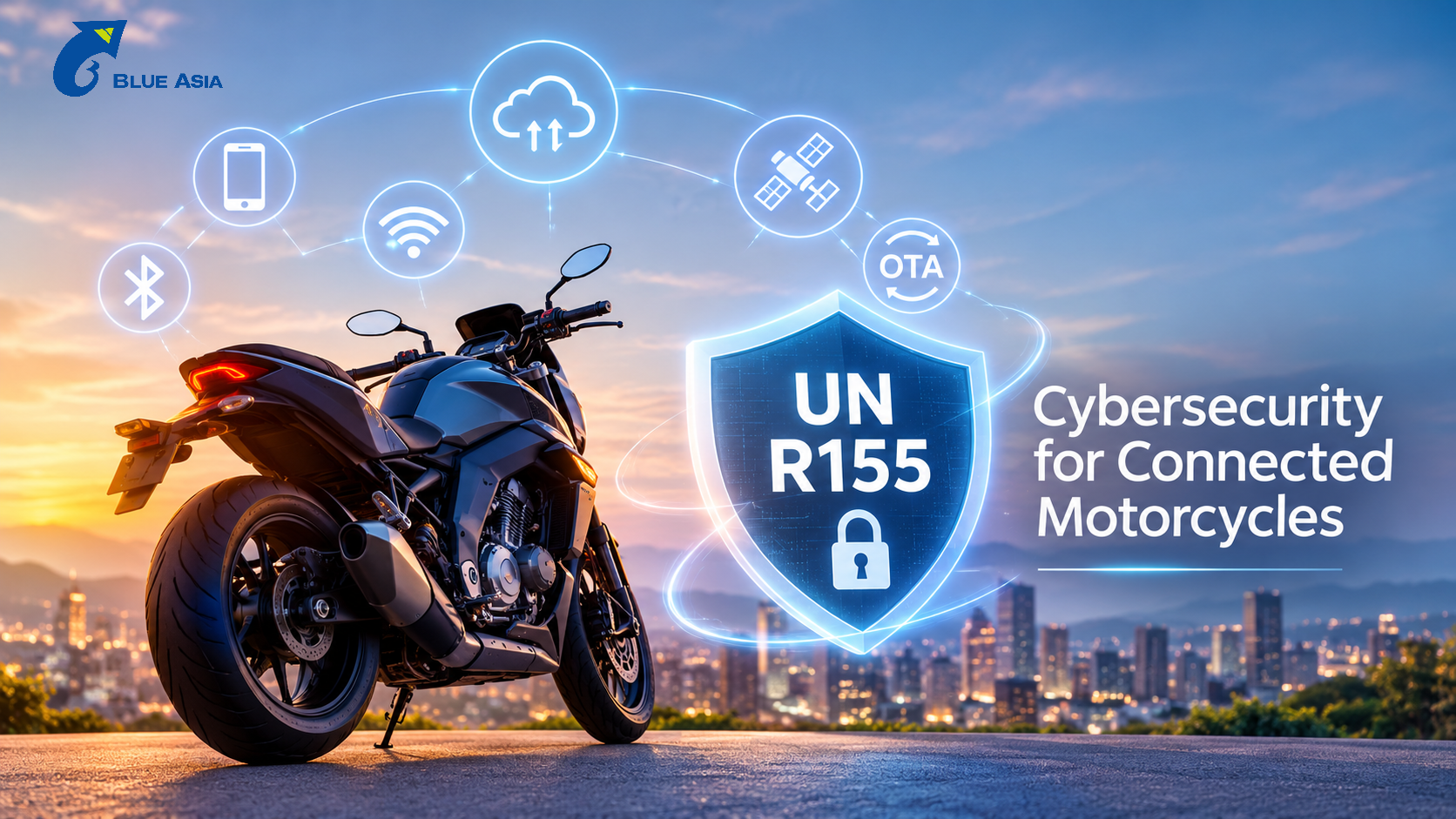
The Connected Motorcycle Is Becoming a Cybersecurity System
Consider a modern motorcycle with:
Bluetooth
Wi-Fi
Smartphone App
Cloud connection
GPS/GNSS
OTA updates
Digital dashboard
T-Box
Central Gateway
TPMS
Connected ECU
Mobile network connectivity
These functions are not independent.
A simplified architecture may look like:
External Interface → Gateway → ECU → Firmware → Smartphone App → Cloud
Every connection potentially creates another attack surface.
For example:
A smartphone connects through Bluetooth.
↓
The dashboard communicates with another ECU.
↓
The T-Box connects to the cellular network.
↓
The motorcycle communicates with a cloud platform.
↓
Software updates are delivered remotely.
The compliance question becomes much larger than Bluetooth or Wi-Fi certification.
1. Start With the Attack Surface, Not the Test Report
One common mistake is starting cybersecurity planning from a list of documents.
Start with the architecture.
Ask:
What can connect to the motorcycle?
Bluetooth?
Can a nearby device discover, pair with or communicate with the motorcycle?
Wi-Fi?
Is the motorcycle creating an access point or joining an external network?
Smartphone App?
Can users remotely unlock, locate, configure or control functions?
Cloud?
What vehicle data leaves the motorcycle? What commands can return?
T-Box?
Which ECUs can it communicate with?
Gateway?
Does it separate external networks from safety-relevant vehicle networks?
OTA?
Who can initiate an update, authenticate it and recover from a failed update?
TPMS / GNSS / connected ECU?
Can compromised information influence another vehicle function?
This is the beginning of a meaningful TARA — Threat Analysis and Risk Assessment.
2. Bluetooth and Wi-Fi Are Not Just “Radio Functions”
This is where many connected motorcycle projects need to change their mindset.
A Bluetooth or Wi-Fi module may already have passed:
CE / RED
FCC
ISED
EMC
RF testing
That proves important regulatory requirements.
But it does not automatically demonstrate that the complete motorcycle architecture is adequately protected against cybersecurity threats.
For example, the question is not only:
“Does the Bluetooth radio meet the RF requirements?”
It can also become:
“What can an authenticated or unauthenticated Bluetooth connection access?”
The same applies to Wi-Fi.
A compliant wireless interface can still become a cybersecurity concern if its connection path reaches sensitive vehicle functions.
Radio compliance and vehicle cybersecurity are different evidence layers.
3. The Gateway Is Becoming a Critical Compliance Component
As motorcycle electronics become more centralized, the Central Gateway can become one of the most important cybersecurity boundaries.
A typical architecture may contain:
Bluetooth / Wi-Fi / Cellular
↓
Central Gateway
↓
Vehicle Network
↓
ECUs
The gateway should not simply be viewed as a communication device.
It can become part of the vehicle's cybersecurity architecture.
Questions for the engineering team include:
Which external interfaces can reach the gateway?
Which ECUs are accessible through each interface?
Are network boundaries clearly defined?
Are authentication and authorization mechanisms implemented?
Can diagnostic functions be remotely accessed?
What happens after a compromised connection?
Can an OTA update reach safety-relevant ECUs?
Are security events monitored and recorded?
These questions are much closer to vehicle cybersecurity engineering than conventional RF testing.
4. What About the Smartphone App and Cloud?
This is another area that motorcycle manufacturers sometimes overlook.
The motorcycle may be secure at the ECU level while the connected ecosystem introduces another risk path.
For example:
Motorcycle → Cellular/Wi-Fi → Cloud → Smartphone App
Now cybersecurity assessment may need to consider:
User authentication
API access
Data transmission
Remote commands
Account management
Access control
OTA authorization
Firmware integrity
Cloud-to-vehicle communication
Vulnerability management
The vehicle is no longer an isolated electronic product.
It is part of a connected ecosystem.
5. OTA Changes the Compliance Conversation
OTA is particularly important.
Suppose the motorcycle passes its original validation with:
Firmware Version 1.0
Six months later, the manufacturer releases:
Firmware Version 2.0
The hardware may be unchanged.
But the software could modify:
Bluetooth behavior
Wi-Fi functionality
Gateway communication
Cellular connectivity
Diagnostic access
ECU communication
Security mechanisms
Remote functions
That is why UN R155 and UN R156 should be considered together for connected motorcycle development.
R155 focuses on cybersecurity and the Cyber Security Management System, while R156 addresses software updates and the Software Update Management System. UNECE maintains both regulations within its vehicle cybersecurity/software-update framework.
The key principle is:
OTA does not automatically mean re-certification.
But it also does not mean:
“No hardware change = no compliance impact.”
Every significant software change should have a documented impact assessment.
6. A Practical Connected Motorcycle Cybersecurity Checklist
Before SOP, I recommend motorcycle manufacturers review at least these areas:
| Area | Key Question |
|---|---|
| Bluetooth | What vehicle functions can the interface access? |
| Wi-Fi | Can an external network reach internal vehicle systems? |
| Smartphone App | What commands can the user send remotely? |
| Cloud | What data and control paths exist? |
| T-Box | Which ECUs and networks can it communicate with? |
| Gateway | Are external and internal networks properly separated? |
| GNSS | Can manipulated positioning data affect vehicle functions? |
| TPMS | Can external data influence vehicle decisions? |
| OTA | How are updates authenticated, delivered and recovered? |
| ECU | How are software and diagnostic interfaces protected? |
| Firmware | Is version/configuration control maintained? |
| TARA | Have cybersecurity risks been assessed across the complete architecture? |
The goal is not to create a larger testing checklist.
The goal is to establish traceable cybersecurity evidence from architecture → risk → mitigation → validation → production configuration.
7. What Motorcycle Suppliers Should Prepare
If you supply a:
Connected dashboard
T-Box
Bluetooth/Wi-Fi module
Gateway
Telematics ECU
TPMS
Smartphone-connected device
OTA-enabled ECU
do not wait until the vehicle manufacturer asks for cybersecurity evidence.
Prepare your supplier evidence early.
At minimum, understand:
Product Configuration → Interfaces → Network Access → Threats → Security Controls → Validation → Firmware Version → Update Mechanism
Your component evidence will not automatically become vehicle-level R155 evidence.
The vehicle manufacturer still needs to understand how your product fits into the complete cybersecurity architecture.
The Bigger Picture
The motorcycle industry is moving toward the same connected-vehicle architecture already seen in passenger cars:
Wireless Connectivity + Gateway + ECU + Cloud + OTA + Smartphone
That means cybersecurity is becoming part of the product architecture—not something added immediately before certification.
For motorcycle OEMs and suppliers, the most useful question to ask now is not:
“When does UN R155 become mandatory for us?”
Ask instead:
“If our motorcycle had to demonstrate cybersecurity readiness tomorrow, could we explain every external interface, every attack surface and every mitigation?”
If the answer is no, the engineering work should probably start before the certification deadline.
How BlueAsia Can Support Connected Motorcycle Projects
At BlueAsia Labs, our work with connected vehicle and two-wheeler electronics sits across RF, EMC, Bluetooth, Wi-Fi, IoT and automotive compliance.
For connected motorcycle projects, we can support teams with:
Wireless and RF validation
Bluetooth / Wi-Fi testing
EMC assessment
Connected-device pre-compliance review
Automotive electronics validation
Configuration and evidence review
Connectivity architecture risk identification
Compliance planning for global market access
The objective is not simply to produce another test report.
It is to help manufacturers identify where wireless connectivity, vehicle electronics and compliance evidence intersect before those issues become expensive production-stage problems.
The more connected the motorcycle becomes, the less “simple” its compliance architecture becomes.
If your motorcycle has Bluetooth, Wi-Fi, T-Box, gateway, smartphone connectivity or OTA, now is a good time to review its cybersecurity architecture.
Need help assessing your connected motorcycle compliance roadmap? Contact BlueAsia Labs.
 ブログ
Why Multi-Market Vehicle Development Is Replacing Single-Market Design
記事を読む
 ブログ
The Biggest DAB+ Problem Isn't Reception. It's Platform Architecture
記事を読む
 ブログ
Saudi SASO 2944 Mandatory Date Delayed to 2028: What Evidence Must eCall Manufacturers Still
記事を読む
 ブログ
Your Motorcycle Has Bluetooth, Wi-Fi and a Connected Display. Is It Ready for UN R155?
記事を読む
 ブログ
Bluetooth BQB: What Product Teams Should Clarify at Project Start
記事を読む
 ブログ
From 2G/3G to 4G/5G: What EU eCall Regulation 2024/1180 Means for Manufacturers
記事を読む
関連サービス

 4000259520