
 English
 Français
 Español
 العربية
 繁体中文
 简体中文


Your Base Vehicle Is Already R155 Approved. What Happens When a Body Builder Adds New Electronics?
The base truck is already UN R155 approved.
Then a body builder adds a T-Box.
Another supplier adds a gateway.
A third company installs a connected display, fleet-management device or camera system.
The vehicle still uses the same chassis.
So the assumption is:
“The vehicle already has R155 approval. Our added electronics should be covered.”
This is where many truck, bus, special-purpose vehicle and telematics projects become unclear.
The real question is not simply:
“Who has the R155 certificate?”
It is:
“What happens to the vehicle's cybersecurity risk when the E/E architecture changes after the base vehicle approval?”
Multi-Stage Vehicles Are Becoming a Cybersecurity Question
A typical commercial-vehicle project may look like this:
Base Vehicle OEM
↓
Body Builder / Converter
↓
T-Box / Gateway Supplier
↓
Infotainment / Display Supplier
↓
Fleet Management / Cloud Platform
Each party may control a different part of the final vehicle.
But cybersecurity does not stop at organizational boundaries.
UN Regulation No. 155 requires the vehicle manufacturer to identify risks to the vehicle type, including interactions with external systems, and to implement proportionate mitigations. It also requires manufacturers to manage cybersecurity-related dependencies with contracted suppliers and service providers.
That creates a practical challenge for multi-stage vehicle development:
If another company changes the E/E architecture, who evaluates the new cybersecurity risk?
The Most Important Distinction: Modification vs. Addition
Not every body modification creates the same cybersecurity impact.
Consider two examples.
Example A — Low Connectivity Impact
A body builder modifies:
Seats
Storage
Mechanical body structure
Exterior panels
without adding a new electronic connection to the vehicle network.
The cybersecurity impact may be limited.
Example B — Cyber-Relevant Modification
A body builder adds:
T-Box
CAN gateway
Telematics ECU
Fleet-management system
Connected camera
Wi-Fi hotspot
Bluetooth device
Remote-control system
New diagnostic interface
Cloud-connected ECU
Now the situation is different.
The new equipment may create:
New external interfaces → New attack surfaces → New threats → New risk assessment
This does not automatically mean that the body builder must obtain a completely separate R155 approval.
It means the cybersecurity impact on the final vehicle must be assessed and responsibilities clearly allocated.
That distinction is critical.
Why a T-Box Can Change the Risk Profile
A T-Box may look like just another electronic component.
But technically, it can connect:
Cellular Network
↓
T-Box
↓
CAN / Ethernet
↓
Vehicle ECUs
↓
Gateway
↓
Vehicle Functions
And potentially:
Cloud
↓
T-Box
↓
Vehicle
This creates interfaces that may not have existed in the original base-vehicle configuration.
The cybersecurity question therefore becomes:
What can the new device access, receive, transmit or control?
A device with cellular connectivity and read/write access to vehicle networks deserves a very different assessment from a display that has no vehicle-network connection.
Multi-Stage Vehicle Cybersecurity Responsibility Matrix
Instead of asking “Who owns R155?”, I recommend manufacturers create a responsibility matrix like this:
| Party | Typical Responsibility |
|---|---|
| Base Vehicle OEM | Vehicle-level cybersecurity architecture and original risk assessment |
| Body Builder | Assessment of cybersecurity impact from added systems/modifications |
| T-Box Supplier | Product cybersecurity risks, interfaces and technical evidence |
| Gateway Supplier | Network access control and interface security evidence |
| Infotainment Supplier | Connectivity, interfaces and product-level cybersecurity evidence |
| Cloud / Fleet Provider | Relevant backend and communication security controls |
| Final Vehicle Manufacturer / Approval Holder | Overall responsibility within the applicable approval framework |
The exact allocation depends on the vehicle approval structure, contracts and applicable regulatory arrangements.
The important point is:
Cybersecurity responsibility cannot simply disappear between companies.
The Five Questions Every Body Builder Should Ask
Before adding a connected system to an R155-approved vehicle, ask:
1. Does the new equipment connect to the vehicle network?
CAN? CAN FD? Automotive Ethernet? Diagnostic interface?
If yes, document exactly what it can read and write.
2. Does it introduce an external communication path?
For example:
Cellular / Wi-Fi / Bluetooth / USB / Cloud
If yes, identify the new attack surface.
3. Can it influence an existing vehicle function?
Reading vehicle data is different from sending commands to vehicle ECUs.
The read/write boundary matters.
4. Was this interface included in the original vehicle cybersecurity assessment?
If not, the original evidence may not automatically cover the new configuration.
5. Who is responsible for the updated risk assessment?
This should be defined before production, not after a technical service asks for evidence.
TARA Should Follow the Final Architecture
One of the most common mistakes is performing cybersecurity assessment based only on the supplier's component.
For example:
T-Box Supplier TARA
may correctly assess the T-Box itself.
But the vehicle manufacturer may still need to understand:
T-Box → Gateway → CAN → ECU
The risk can change when the component is integrated into the vehicle.
UN R155 requires risk assessment to consider individual elements of the vehicle type and their interactions, including interactions with external systems.
Therefore:
Component cybersecurity evidence is useful. It is not automatically equivalent to vehicle-level cybersecurity evidence.
This is especially important for connected commercial vehicles.
What Evidence Should a T-Box Supplier Provide?
If you supply a T-Box, don't wait for the OEM to ask for “the R155 document.”
Prepare a structured technical evidence package.
For example:
Product Configuration
Hardware version
Cellular module
GNSS module
Antenna configuration
Firmware version
Communication interfaces
Cybersecurity Information
External interfaces
CAN/Ethernet access
Authentication
Secure communication
Access control
Update mechanism
Vulnerability management
Integration Information
Network architecture
Data flows
Read/write permissions
Gateway dependencies
Cloud connection
Diagnostic access
Validation Evidence
Security testing
Interface testing
Vulnerability assessment
Communication testing
Relevant RF/EMC evidence
Software/configuration records
This allows the OEM or final vehicle manufacturer to incorporate the supplier's evidence into the vehicle-level cybersecurity assessment.
What About a Connected Display?
This is another common situation.
A body builder installs a smart display with:
Bluetooth + Wi-Fi + cellular + CAN
The supplier may say:
“The display already passed CE and FCC.”
That does not answer the R155 question.
CE/FCC evidence can establish applicable radio, EMC or other product-level compliance.
It does not automatically demonstrate that the device is safe from a vehicle cybersecurity architecture perspective.
The key question is:
What can this display access inside the vehicle?
If it is completely isolated, the risk profile may be relatively limited.
If it can access vehicle networks, diagnostics, gateways or cloud services, the cybersecurity assessment becomes much more significant.
Multi-Stage Vehicle ≠ “One More ECU”
This is the mindset I would like engineering teams to change.
When adding electronics to a commercial vehicle, don't ask only:
“Does this ECU work?”
Ask:
“What new connection did we create?”
Then:
“What new data can cross that connection?”
Then:
“What vehicle functions can potentially be affected?”
And finally:
“Has that change been incorporated into the vehicle cybersecurity evidence?”
That sequence is much more useful than simply collecting component certificates.
A Practical Pre-Production Checklist
Before SOP, the project team should be able to answer:
☐ Final E/E architecture is documented
☐ Added ECUs are identified
☐ CAN/Ethernet interfaces are documented
☐ Read/write permissions are defined
☐ Cellular/Wi-Fi/Bluetooth interfaces are identified
☐ External communication paths are mapped
☐ TARA impact has been assessed
☐ Supplier cybersecurity evidence is available
☐ Responsibilities between OEM and body builder are documented
☐ Production hardware/software configuration is frozen
☐ Changes after validation are controlled
If several boxes are still unclear, the project may have a cybersecurity evidence gap, even if the base vehicle already has R155 approval.
Why This Matters for Trucks, Buses and Special-Purpose Vehicles
The issue becomes more complicated as commercial vehicles become increasingly connected.
A modern truck may include:
Telematics
Fleet management
Remote diagnostics
Driver displays
Camera systems
ADAS
TPMS
Bluetooth
Wi-Fi
Cellular connectivity
Cloud services
OTA updates
A special-purpose vehicle may then add another layer of electronics.
More interfaces mean more potential dependencies.
UNECE's recent R155/R156 implementation workshops specifically included the application of these regulations to multi-stage vehicles, with participation from approval authorities, technical services and industry stakeholders.
That tells us something important:
Multi-stage cybersecurity is not a theoretical issue. The regulatory community is actively working through how it should be implemented.
Where BlueAsia Can Help
BlueAsia works with commercial-vehicle manufacturers, body builders, T-Box suppliers, telematics companies, infotainment suppliers and connected-vehicle electronics manufacturers.
Our advantage is that cybersecurity-related vehicle changes often sit alongside other technical compliance issues.
For example:
New T-Box
→ Cellular / GNSS
→ Antenna & RF
→ EMC
→ CAN / vehicle integration
→ Bluetooth / Wi-Fi
→ eCall
→ R155/R156 evidence
Our laboratory capabilities include:
RF + EMC + Bluetooth + Wireless + Automotive Electronics + IoV Connectivity + Compliance Evidence Review
We can help manufacturers identify the technical impact of a new electronic system before it becomes a late-stage approval problem.
The Question to Ask Before Adding Any ECU
If your base vehicle already has UN R155 approval, don't assume the job is finished when a new body builder or supplier adds electronics.
Ask:
“Does this modification change the vehicle's cybersecurity attack surface or its interaction with external systems?”
If the answer is yes, determine:
What changed?
→ Who owns the risk assessment?
→ What evidence must the supplier provide?
→ Does the final vehicle configuration remain within the existing approval scope?
→ What needs to be reassessed before SOP?
That is the real challenge of multi-stage vehicle cybersecurity.
The base vehicle may already be approved.
The final connected vehicle still needs to be understood.
If you are developing a truck, bus, special-purpose vehicle, T-Box, gateway or connected commercial-vehicle system, BlueAsia can help review the RF/EMC, connectivity, vehicle integration and compliance evidence around your new electronic configuration.
 ブログ
Why Software Updates Are Creating Supplier Management Challenges
記事を読む
 ブログ
Why Certification Engineers Need to Think Like System Architects
記事を読む
 ブログ
C-V2X RSU & OBU Certification: How to Plan OmniAir, FCC and CE in Parallel
記事を読む
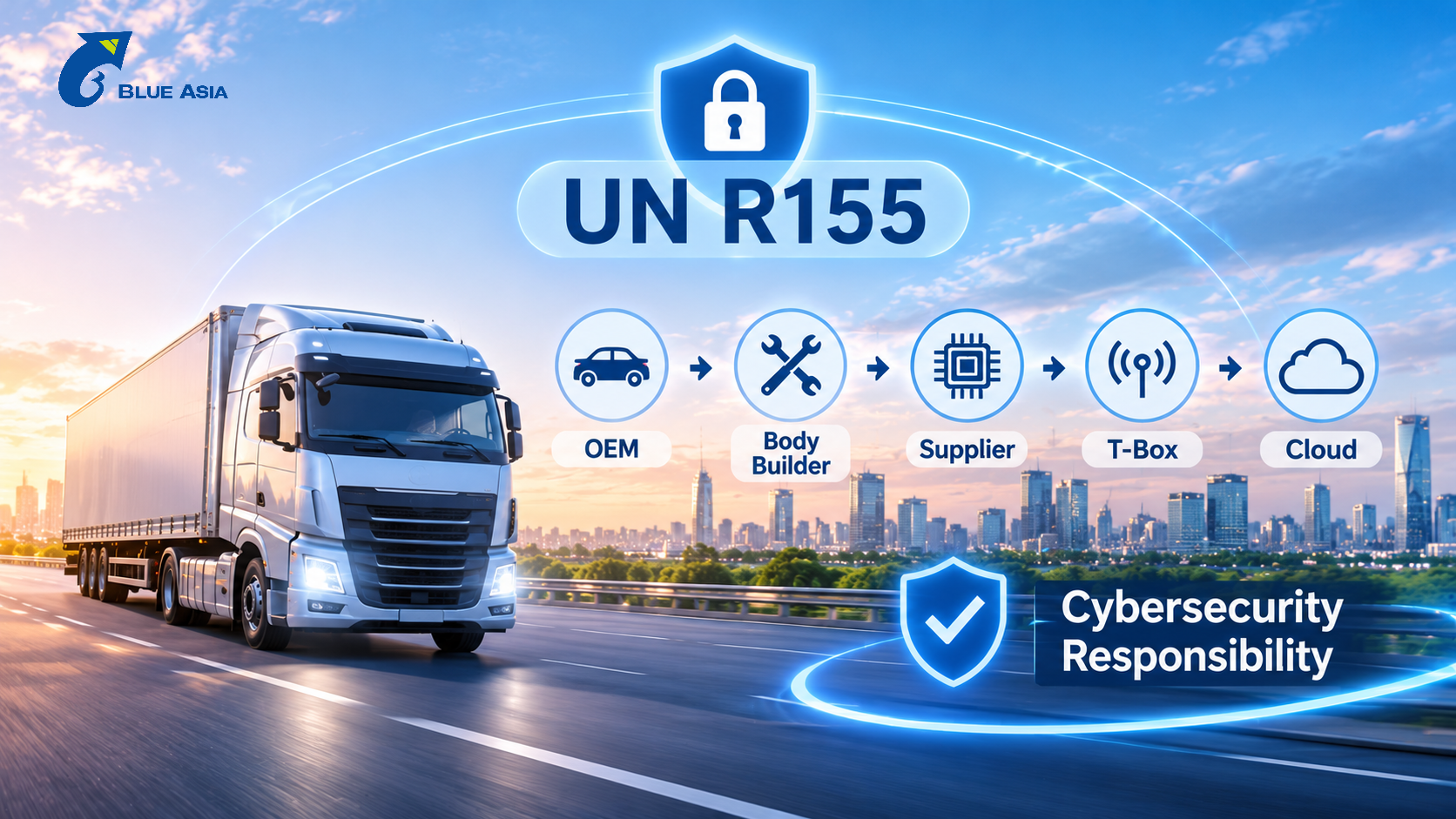 ブログ
Your Base Vehicle Is Already R155 Approved. What Happens When a Body Builder Adds New Electr
記事を読む
 ブログ
Planning Wireless Certification Before Product Design Freeze
記事を読む
 ブログ
Understanding the MFi Program in a CarPlay Product Development Plan
記事を読む
関連サービス

 4000259520