
 English
 Français
 Español
 العربية
 繁体中文
 简体中文

Why Software Updates Are Creating Supplier Management Challenges
Why Software Updates Are Creating Supplier Management Challenges
Your supplier updated one software module.
Your entire compliance strategy changed.
For many automotive companies, this sounds like an exaggeration.
After all, software updates happen every day.
But in modern vehicle development, one supplier's software change can affect much more than a single function.
It can influence:
Product configuration
Technical documentation
Software traceability
Validation planning
Global approvals
Lifecycle management
The automotive industry is entering an era where suppliers no longer deliver only hardware.
Increasingly, they deliver software that continues evolving long after production begins.
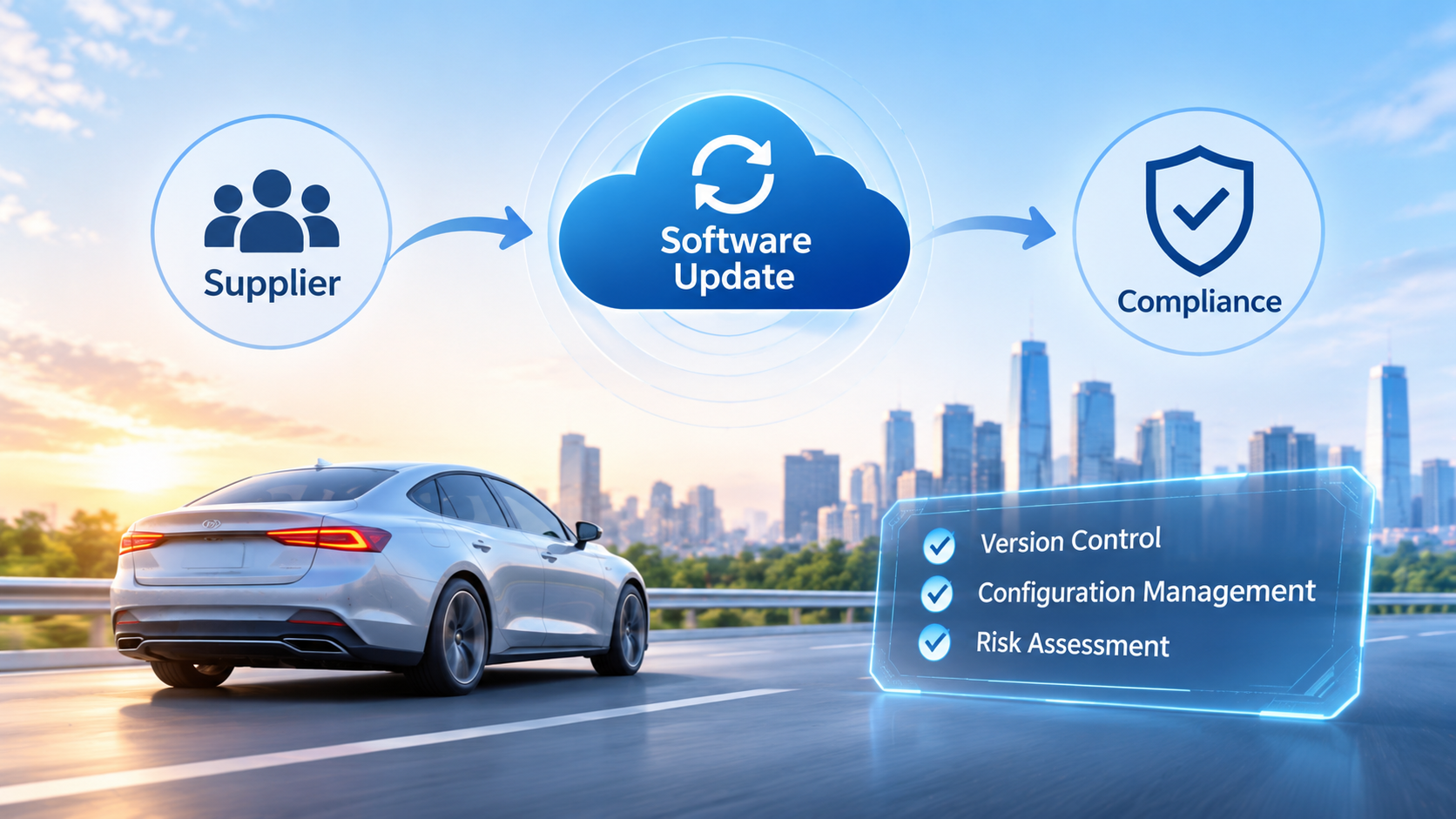
That is why Supplier Management is becoming one of the most important parts of modern Vehicle Software compliance.
Suppliers are no longer shipping fixed products
Traditionally, suppliers delivered physical components such as:
Electronic Control Units (ECUs)
Sensors
Displays
Wireless modules
Wiring assemblies
Once integrated into the vehicle, these products changed relatively little.
Today, many suppliers provide:
Firmware
Middleware
Connectivity stacks
AI functions
Cloud services
OTA software components
Unlike hardware, software is expected to evolve throughout the vehicle lifecycle.
That changes the relationship between OEMs and suppliers.
One software update can affect multiple systems
Imagine a supplier releases a software update to improve Bluetooth performance.
The update appears small.
But it may also influence:
Wi-Fi coexistence
CarPlay or Android Auto behavior
System startup timing
Resource scheduling
User experience
Software version records
The change itself may be beneficial.
The challenge is understanding its impact on the complete vehicle.
This is why software updates increasingly require system-level evaluation—not just functional testing.
Version control is becoming a business requirement
Many organizations still manage supplier software through simple version numbers.
That is no longer enough.
Modern development teams increasingly need to know:
Which software version is installed?
Which supplier released the update?
Which vehicles received it?
What functions changed?
Which validation activities were completed?
Without clear Version Control, even answering a customer's technical question can become difficult.
Version management is no longer only an engineering task.
It is becoming a core business capability.
Configuration management connects everything together
As software complexity grows, Configuration Management becomes essential.
It helps organizations understand the relationship between:
Hardware
Software
Vehicle variants
Suppliers
Features
Documentation
For example, a single vehicle platform may contain software from dozens of suppliers.
If one supplier changes a communication library or connectivity module, manufacturers need to know:
Which products are affected?
Which markets are affected?
Which technical documents require updates?
Does additional validation become necessary?
Without configuration visibility, these questions become increasingly difficult to answer.
Supplier collaboration is changing
In the past, supplier relationships often ended after component delivery.
Today, collaboration continues throughout the product lifecycle.
Suppliers now contribute to:
OTA updates
Software maintenance
Security patches
Feature improvements
Performance optimization
This means compliance is no longer managed only within the OEM.
It increasingly depends on communication and change management across the entire supply chain.
Future compliance depends on change management
Successful organizations no longer ask only:
"Did the supplier deliver the software?"
They also ask:
How will future updates be managed?
Can software changes be traced?
Who approves new versions?
How are risks evaluated?
How are affected vehicle configurations identified?
The challenge is not preventing software updates.
The challenge is managing them with confidence.
Five questions every product team should ask
Before accepting supplier software updates, consider:
✅ Can every software version be traced to a specific supplier release?
✅ Does configuration management link hardware and software correctly?
✅ Have software changes been evaluated before deployment?
✅ Can affected vehicle variants be identified quickly?
✅ Are supplier update processes aligned with your compliance strategy?
These questions are becoming essential as software-defined vehicles continue to evolve.
Final Thoughts
The automotive supply chain is changing.
Suppliers are no longer delivering only hardware.
They are delivering software that continues evolving throughout the product lifecycle.
That means successful Supplier Management is no longer only about cost, quality or delivery.
It is increasingly about managing software updates, configuration, traceability and lifecycle compliance.
Because in the era of Software-Defined Vehicles, one supplier update can influence far more than one software module.
It can influence the compliance strategy of the entire vehicle.
Join the discussion
How does your organization manage supplier software updates today?
Do you see Version Control, Configuration Management, or supplier collaboration as the biggest challenge for future vehicle development?
I'd love to hear your perspective in the comments.
 ブログ
Why Software Updates Are Creating Supplier Management Challenges
記事を読む
 ブログ
Why Certification Engineers Need to Think Like System Architects
記事を読む
 ブログ
C-V2X RSU & OBU Certification: How to Plan OmniAir, FCC and CE in Parallel
記事を読む
 ブログ
Your Base Vehicle Is Already R155 Approved. What Happens When a Body Builder Adds New Electr
記事を読む
 ブログ
Planning Wireless Certification Before Product Design Freeze
記事を読む
 ブログ
Understanding the MFi Program in a CarPlay Product Development Plan
記事を読む
関連サービス

 4000259520