
 English
 Français
 Español
 العربية
 繁体中文
 简体中文


Why Multi-Market Vehicle Development Is Replacing Single-Market Design
Why Multi-Market Vehicle Development Is Replacing Single-Market Design
Building one product for one country is becoming a luxury.
Not long ago, many vehicle programs were developed with a single target market in mind.
A product designed for one region would be optimized for one set of regulations, one customer group and one deployment strategy.
That model is rapidly changing.
Today, manufacturers are expected to launch vehicles across multiple regions, often using the same hardware platform and software architecture.
This shift is transforming Vehicle Development.
Success is no longer determined only by engineering performance.
It increasingly depends on how efficiently a product can adapt to different regional requirements.
One platform, many markets
Modern automotive programs are built around global platforms.
A single platform may support vehicles sold in:
Europe
Saudi Arabia
Australia
Japan
North America
Southeast Asia
This approach reduces development cost and accelerates product launches.
But it also introduces a new challenge.
The platform may be global.
The compliance requirements are not.
Regional configuration is becoming the real engineering task
Many companies assume global market access simply means completing additional certifications.
In reality, the bigger challenge is Regional Configuration.
Manufacturers increasingly need to configure products for:
Wireless frequency allocations
Digital broadcasting requirements
Emergency communication systems
Language support
User interface behavior
Connected services
Software features
The hardware may remain unchanged.
The product behavior often cannot.
That is why regional configuration is becoming a core capability in modern Automotive Electronics development.
Compliance differences are moving beyond RF testing
Traditional compliance focused on questions such as:
Does the product meet EMC requirements?
Does the radio comply with local spectrum rules?
These questions remain important.
However, connected vehicles now face additional regional expectations.
For example:
A vehicle developed for Europe may include DAB+ functionality that performs well in its original market.
But entering another region may require additional considerations related to broadcasting behavior, localization or service integration.
Similarly, emergency communication functions such as NG eCall may need to align with different regulatory frameworks and network environments depending on the target market.
These differences are increasingly about how the product behaves, not only how it performs.
Platform flexibility reduces future redesign
One of the most valuable characteristics of a global vehicle platform is flexibility.
Instead of redesigning hardware for every market, manufacturers increasingly rely on configurable software and modular architectures.
Examples include:
Market-specific software configurations
Local language packages
Feature activation by region
Wireless configuration management
Market-dependent compliance documentation
The objective is simple:
Adapt the product without redesigning the platform.
This significantly reduces engineering effort and accelerates global deployment.
Product planning now determines market expansion
Regional compliance is no longer something to consider after engineering is complete.
Questions such as these should be discussed much earlier:
Which markets will the platform support over the next five years?
Which regional requirements should be anticipated now?
Can the software architecture support future localization?
Will wireless functions require market-specific configurations?
Can new compliance requirements be introduced without redesigning the vehicle?
These decisions often influence future expansion more than laboratory testing itself.
The future belongs to configurable products
As vehicles become software-defined, global platforms are evolving into configurable platforms.
Manufacturers are moving away from building different products for different countries.
Instead, they are building one adaptable product capable of supporting multiple regional requirements through controlled configuration.
This shift is changing how engineering, compliance and product management work together.
Five questions every product team should ask
Before launching a global vehicle platform, consider:
✅ Can the platform support multiple regional configurations without hardware redesign?
✅ Have future target markets been considered during product planning?
✅ Can software features be adapted for regional requirements?
✅ Is the compliance strategy scalable across multiple countries?
✅ Does the architecture support long-term global expansion?
These questions increasingly define the success of international vehicle programs.
Final Thoughts
The future of Vehicle Development is not about creating more products.
It is about creating smarter platforms.
As automotive manufacturers expand into more regions, the ability to manage Regional Compliance through flexible configuration will become a major competitive advantage.
The companies that succeed globally will not necessarily build the most hardware.
They will build the most adaptable platforms.
Because in the era of connected and software-defined vehicles, one global platform can support many markets—but only if it is designed with regional configuration in mind.
Join the discussion
How does your team approach global vehicle development?
Do you design for one market first and expand later, or build a platform that supports multiple regions from the beginning?
I'd love to hear your perspective in the comments.
 ブログ
Why Multi-Market Vehicle Development Is Replacing Single-Market Design
記事を読む
 ブログ
The Biggest DAB+ Problem Isn't Reception. It's Platform Architecture
記事を読む
 ブログ
Saudi SASO 2944 Mandatory Date Delayed to 2028: What Evidence Must eCall Manufacturers Still
記事を読む
 ブログ
Your Motorcycle Has Bluetooth, Wi-Fi and a Connected Display. Is It Ready for UN R155?
記事を読む
 ブログ
Bluetooth BQB: What Product Teams Should Clarify at Project Start
記事を読む
 ブログ
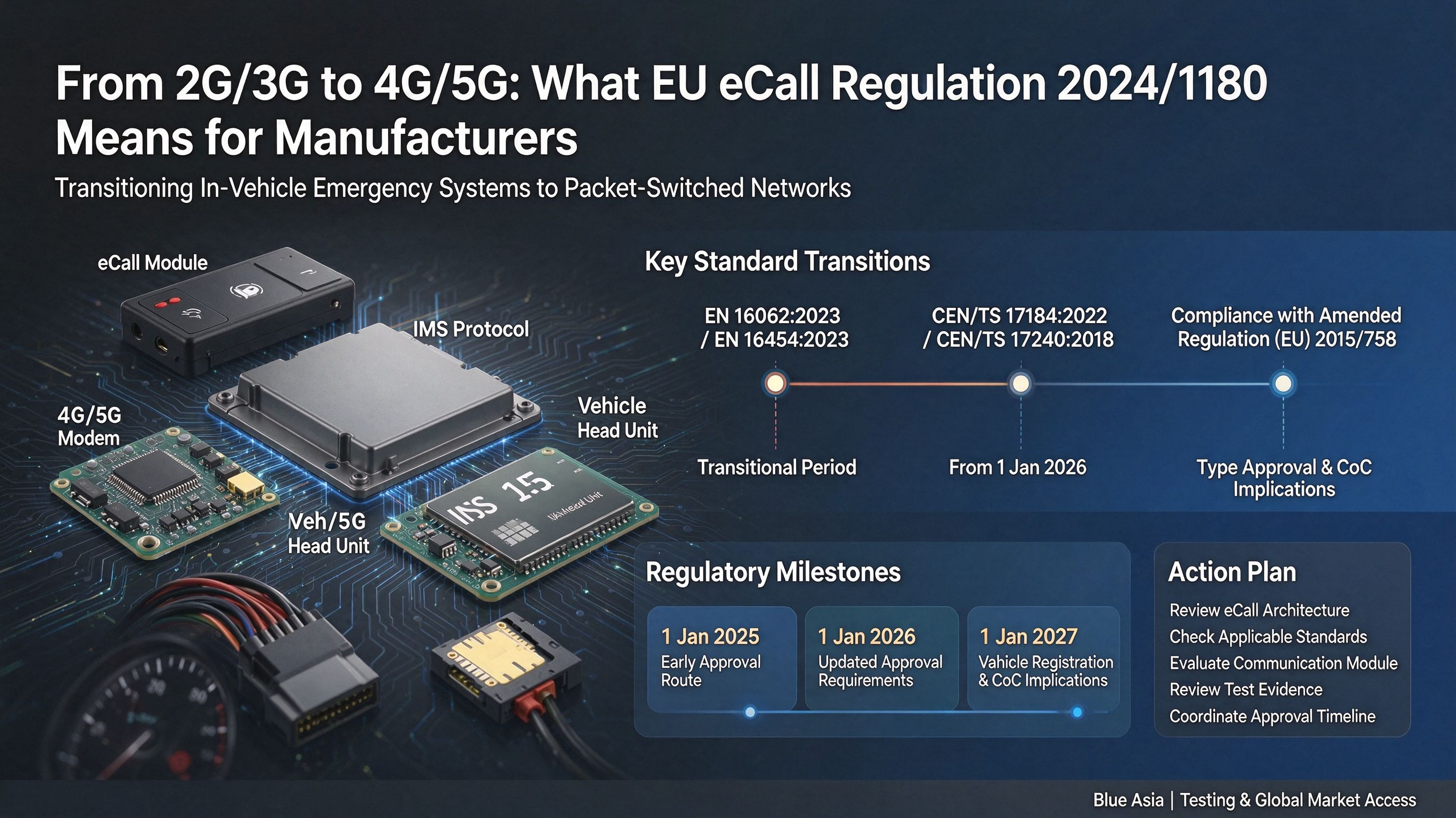
From 2G/3G to 4G/5G: What EU eCall Regulation 2024/1180 Means for Manufacturers
記事を読む
関連サービス

 4000259520