
 English
 Français
 Español
 العربية
 繁体中文
 简体中文


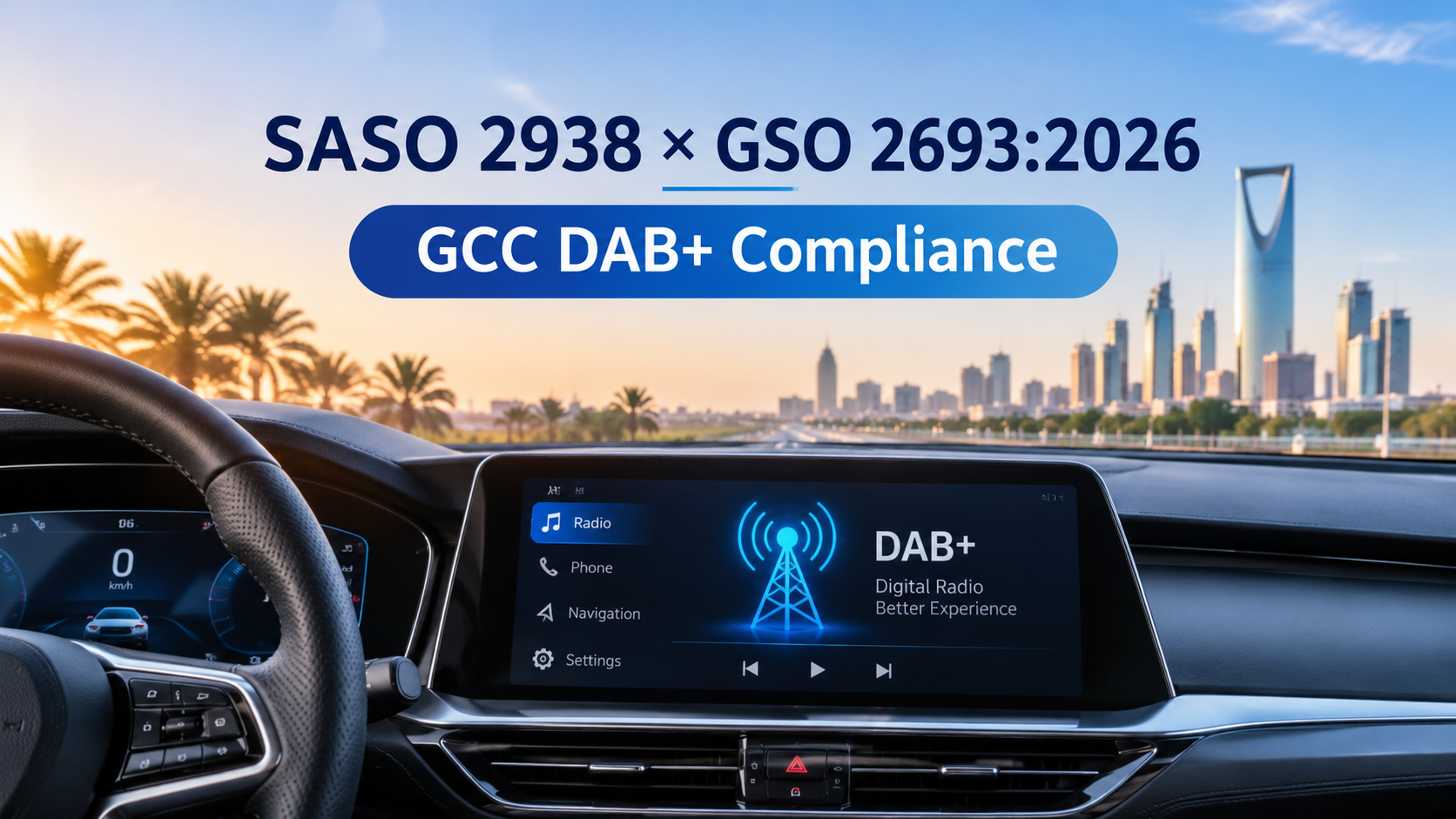
SASO 2938 vs GSO 2693: What the 2026 GCC DAB+ Requirements Mean for In-Vehicle Radio Receivers
SASO 2938 vs GSO 2693: What the 2026 GCC DAB+ Requirements Mean for In-Vehicle Radio Receivers
Is DAB+ now mandatory for your vehicle radio in Saudi Arabia? What about aftermarket head units? And does GSO 2693:2026 replace SASO 2938?
For automotive infotainment manufacturers exporting to the Gulf, these questions are becoming increasingly important in 2026.
A traditional AM/FM-only head unit may still work technically. But for vehicles entering markets where terrestrial DAB+ reception is mandatory, the issue is no longer simply about radio performance.
It becomes a question of product configuration, market scope, certification evidence, customs classification and documentation.
Saudi Arabia has required applicable radio receivers to include terrestrial DAB+ capability since 1 January 2021, while imported radio receivers supplied with vehicles have specific application requirements for vehicle model years. SASO states that SASO 2938:2019 covers terrestrial audio broadcast receivers, including AM/FM/T-DAB+.
At the GCC level, GSO 2693:2026 was published in April 2026 and covers AM/FM/T-DAB+ terrestrial radio receivers, including vehicle-integrated and aftermarket devices.
So what should manufacturers actually do?
1. SASO 2938 and GSO 2693 Are Not Simply “Old vs New”
The first mistake is to assume that GSO 2693:2026 automatically replaces every national DAB+ requirement.
Saudi Arabia has its own mandatory framework under SASO 2938:2019.
Meanwhile, GSO 2693:2026 establishes a GCC-level technical specification covering terrestrial AM, FM and T-DAB+ receivers.
The practical relationship is therefore:
Saudi Arabia → Check SASO 2938 and the applicable Saudi conformity route
Other GCC markets → Check GSO 2693:2026 together with the applicable national implementation
This distinction matters because market-access requirements are not determined by the standard number alone.
A manufacturer should always confirm:
Product type + vehicle application + target country + model year + applicable conformity route
before deciding whether an existing report can be reused.
2. Which Vehicles Need DAB+?
For Saudi Arabia, this is no longer an optional “premium infotainment feature” question.
Saudi legislation has required terrestrial DAB+ capability for radio receivers since 1 January 2021, and the Saudi implementation specifically includes vehicle receivers. The GSO motor-vehicle regulatory information also identifies AM/FM/T-DAB+ requirements for Saudi vehicles under SASO 2938:2019.
For the UAE, UAE.S 5021:2018 is mandatory for terrestrial AM/FM/T-DAB+ receivers, with the requirement reaching 100% of vehicles from model year 2024 according to the published UAE implementation information.
This means automotive teams should not evaluate DAB+ only at the “radio module” level.
The real question is:
Does the final vehicle or aftermarket radio product fall within the applicable receiver requirement for the destination market?
3. What About Aftermarket Head Units?
This is where many manufacturers become uncertain.
GSO 2693:2026 explicitly covers more than factory-installed vehicle radios.
Its scope includes:
Vehicle-integrated receivers
Aftermarket dashboard receivers
Devices mounted behind the dashboard
Devices mounted on the windscreen or elsewhere
Standalone radio receivers
Multifunction products containing radio reception functions
It therefore has clear relevance to aftermarket infotainment and car-radio manufacturers, not only OEM vehicle manufacturers.
A multifunction head unit does not escape DAB+ requirements simply because its main functions are:
CarPlay + Android Auto + Bluetooth + Wi-Fi + Navigation
If it also contains a terrestrial AM/FM/T-DAB+ receiver, the applicable radio-receiver requirements must be assessed.
This is especially relevant to aftermarket brands selling one global head-unit platform into multiple GCC countries.
4. The Product Configuration Must Be Frozen Before Testing
For DAB+ compliance, the test report should correspond to the actual commercial configuration.
Before testing, manufacturers should identify:
Radio receiver
DAB+ chipset
RF front end
AM/FM tuner
Receiver architecture
Firmware version
Antenna system
Antenna type
Antenna location
RF cable
Connector
Amplifier, if used
Infotainment platform
Display
Audio amplifier
Speaker configuration
Software version
Service-list and station-selection functions
Vehicle integration
Power supply
Grounding
Vehicle network interfaces
Other wireless modules
A report generated from one receiver configuration cannot automatically be assumed to cover a materially different production configuration.
5. DAB+ Is Not Only About “Receiving a Station”
A modern automotive DAB+ receiver needs to perform more than basic signal reception.
Manufacturers should review functions such as:
Service scanning
Service selection
Ensemble handling
Service labels
Dynamic information
Station-list management
Audio switching
Signal recovery
Reception behaviour
For automotive products, antenna installation and vehicle electromagnetic conditions can also influence the real-world result.
This creates an important distinction:
Laboratory receiver compliance ≠ complete vehicle user experience.
A DAB+ module can perform correctly in a controlled RF environment while the integrated vehicle system experiences reception degradation because of antenna placement, cable loss, DC/DC converter noise or other vehicle electronics.
6. What About Arabic Documentation?
Arabic documentation is not simply a translation exercise.
For Saudi/GCC market access, manufacturers should review the complete product information package, including:
User manual
Safety information, where applicable
Product identification
Model number
Manufacturer information
Product labels
Installation information
Operating instructions
Relevant conformity documents
Saudi conformity services can require explanatory documents such as product manuals, with Arabic language requirements depending on the applicable technical regulation and certification route. SASO's published IECEE requirements, for example, specify Arabic-language documentation for the relevant products.
For radio products, manufacturers should therefore avoid treating Arabic documentation as something to prepare after testing.
The documentation should match the actual model, hardware configuration and commercial name submitted for conformity assessment.
7. What About the DAB+ Label and User Interface?
The Arabic-language user experience can also become part of the technical review.
Regional DAB+ receiver guidance has addressed Arabic/English documentation and receiver display requirements, including the ability to render relevant service information correctly.
For automotive infotainment, manufacturers should therefore review:
Arabic text rendering → station/service labels → dynamic information → menu presentation → user documentation
This is particularly important when the same infotainment platform is sold globally.
A firmware change that adds Arabic-language support may seem unrelated to RF compliance, but it can change the configuration that was originally assessed.
8. What About HS Codes?
This is another area where manufacturers should be careful.
The HS Code is a customs classification, not a substitute for technical conformity assessment.
A complete automotive infotainment product may have several integrated functions:
Radio + Bluetooth + Wi-Fi + GNSS + display + media + smartphone connectivity
Therefore, the correct customs classification should be determined based on the product's actual characteristics and the applicable tariff rules.
Saudi Arabia's ZATCA states that the GCC integrated tariff operates at the 12-digit level from 1 January 2025, and classification is governed by the terms of the tariff headings, notes and applicable classification rules.
So manufacturers should not simply copy an HS code from an old DAB+ report or another model.
Before shipment, confirm:
Product description
Primary function
Integrated functions
Complete product structure
Applicable GCC tariff classification
Destination-country customs requirements
Technical conformity and customs classification should be reviewed separately—but consistently.
9. Can One DAB+ Report Cover the GCC?
Sometimes evidence can be reused.
But the correct question is not:
“Can I use the same report everywhere?”
It is:
“Which part of my existing evidence is technically and regulatorily reusable in each market?”
A useful compliance matrix is:
| Market | Key DAB+ Reference | Product Scope | Existing Report | Additional Review |
|---|---|---|---|---|
| Saudi Arabia | SASO 2938:2019 | Vehicle / receiver | Review | Saudi route |
| UAE | UAE.S 5021:2018 | Vehicle / receiver | Review | UAE route |
| Oman | GSO 2693:2026 | Receiver | Review | National implementation |
| Kuwait | GSO framework | Receiver | Review | National route |
| Qatar | GSO framework | Receiver | Review | National route |
| Bahrain | GSO framework / applicable national route | Receiver | Review | Confirm |
The principle is simple:
One product platform does not necessarily mean one compliance route.
But it also does not mean that every GCC country requires a completely independent DAB+ test campaign.
A country-by-country gap assessment can often identify where existing evidence remains useful.
10. What Should Manufacturers Do in 2026?
For new automotive infotainment projects, we recommend five actions.
1. Confirm the target countries early
Do not wait until shipment to determine whether DAB+ is mandatory.
2. Freeze the radio configuration
Document the tuner, antenna, RF path, firmware and infotainment configuration.
3. Map SASO 2938 vs GSO 2693:2026
Identify which requirement applies to each market.
4. Review Arabic documentation
Check manuals, labels, user interface content and model information before conformity submission.
5. Build an evidence-reuse matrix
Compare existing DAB+ reports against the actual target-market requirements before scheduling additional tests.
This approach can prevent two expensive mistakes:
Under-testing: assuming an old report covers a new market.
Over-testing: repeating an entire DAB+ campaign when only a limited gap needs to be addressed.
11. How BlueAsia Supports GCC DAB+ Compliance
DAB+ is one of BlueAsia Labs' key automotive compliance capabilities.
Our team supports manufacturers and infotainment brands with:
SASO 2938 assessment
GSO 2693:2026 gap assessment
UAE.S 5021 evaluation
GCC country-by-country evidence mapping
DAB+ receiver testing
AM/FM/T-DAB+ evaluation
RF and antenna assessment
Automotive EMC testing
In-vehicle DAB+ performance validation
Arabic technical documentation review
BlueAsia combines RF, EMC, Bluetooth, automotive infotainment and compliance engineering capabilities to evaluate the product as an integrated system rather than treating DAB+ as an isolated module.
Our objective is practical:
Identify the applicable requirement → map existing evidence → find the real gap → perform only the testing that is actually needed.
Final Takeaway
The transition from traditional AM/FM radio to mandatory DAB+ in key GCC markets is no longer a future development.
For Saudi Arabia, DAB+ has already been a regulatory requirement for applicable radio receivers, while the UAE and broader GCC framework continue to strengthen the role of terrestrial digital radio in vehicles.
For manufacturers, the key challenge in 2026 is therefore not simply “Do we have DAB+?”
It is:
Do we have the right DAB+ configuration, the right test evidence, the right country-specific compliance route, the right documentation, and the right customs classification?
That is the difference between having a DAB+ function and having a DAB+ product that is properly prepared for GCC market entry.
Planning to export an AM/FM/DAB+ vehicle radio or infotainment system to Saudi Arabia or the GCC?
Contact BlueAsia Labs for a DAB+ compliance gap assessment covering SASO 2938, GSO 2693:2026, UAE.S 5021, RF testing, in-vehicle validation and GCC evidence reuse.
 ブログ
Why Future Vehicle Certification Will Depend On Digital Traceability
記事を読む
 ブログ
Why SASO 2938 Is Becoming a Software Validation Project
記事を読む
 ブログ
SASO 2938 vs GSO 2693: What the 2026 GCC DAB+ Requirements Mean for In-Vehicle Radio Receive
記事を読む
 ブログ
Your UWB Digital Key Passed RF Testing. Is It Ready for Real Vehicle Access?
記事を読む
 ブログ
FCC Equipment Authorization: Key Inputs to Prepare Before Testing
記事を読む
 ブログ
Preparing Project Information and Responsibilities for an MFi Program
記事を読む
関連サービス

 4000259520