
 English
 Français
 Español
 العربية
 繁体中文
 简体中文


GB 36672-2026: What Electric Motorcycle Battery Manufacturers Need to Prepare Before July 2027
Your electric motorcycle battery may have passed the old standard. But that does not mean it is ready for China’s next mandatory safety requirements.
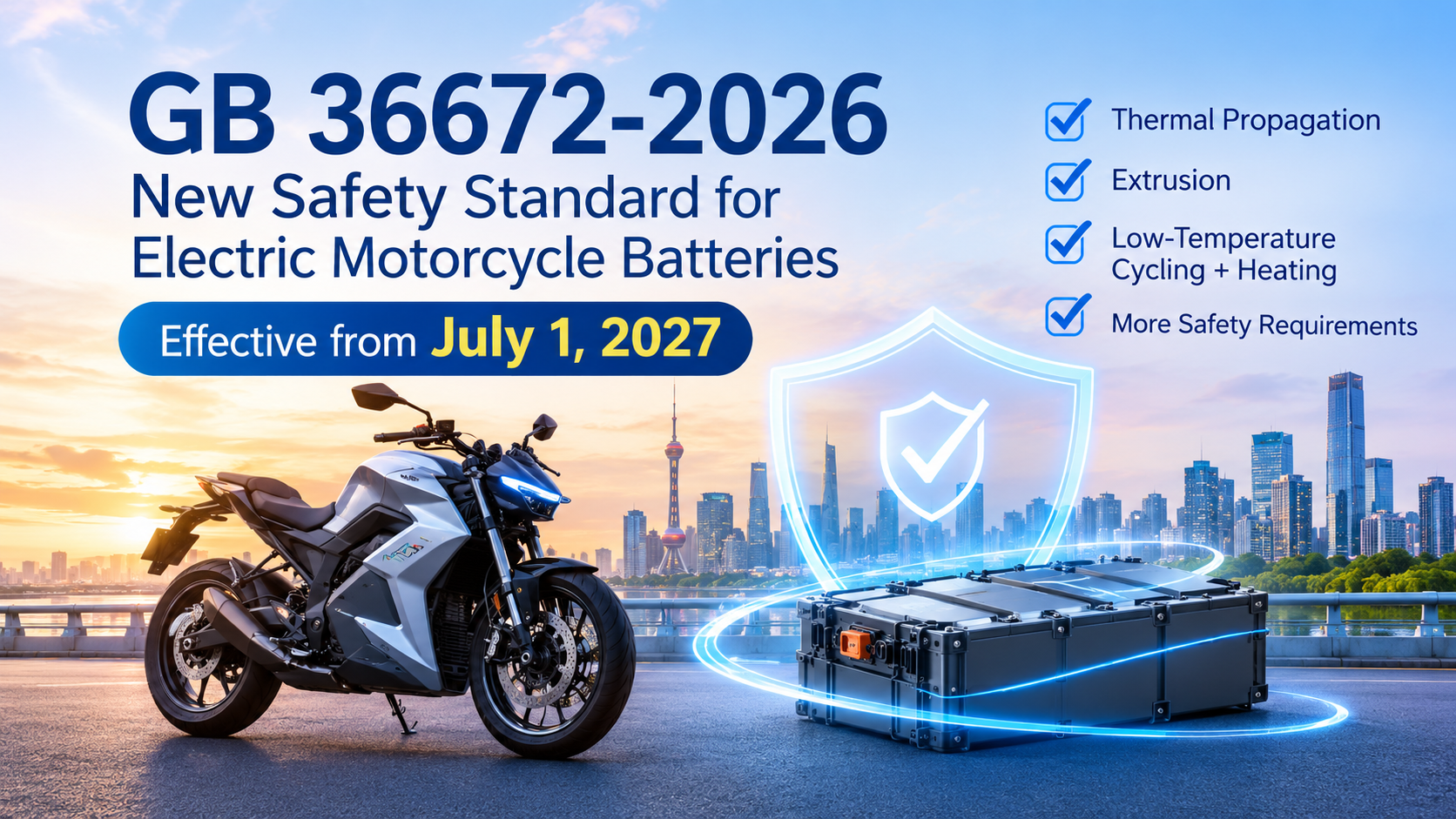
China has published GB 36672—2026, Safety Requirements of Lithium-Ion Batteries for Electric Motorcycles and Electric Mopeds.
The new standard will become mandatory on 1 July 2027, replacing the previous recommended standard GB/T 36672—2018.
For electric motorcycle and electric moped manufacturers, battery suppliers and BMS/Pack developers, this is not simply a change from one test report to another.
The revised standard expands the safety assessment across the cell, battery pack and battery system levels and introduces additional scenarios designed to better reflect mechanical damage, thermal runaway and real-world operating conditions.
If your product is scheduled for production, certification or major model updates in 2027, waiting until the mandatory implementation date may be too late.
1. From Recommended GB/T to Mandatory GB: What Has Changed?
The most important change is regulatory status.
GB/T 36672—2018 was a recommended national standard.
GB 36672—2026 is a mandatory national standard.
This means the new requirements are no longer simply a recommended safety benchmark. Manufacturers need to consider them as part of their product compliance and market-access planning.
The new standard also establishes clearer rules for same-type determination, testing procedures and evaluation criteria, helping reduce inconsistencies in how battery products are assessed.
For manufacturers, this creates a practical question:
Can the battery design that passed GB/T 36672-2018 still pass the new GB 36672-2026 tests?
The answer should be established through a gap assessment—not assumed from the previous test report.
2. The New Standard Expands the Safety Test Scenarios
One of the most important changes is the expansion of test scenarios.
The new standard adds or strengthens requirements including:
Thermal propagation
Extrusion / crushing
Heating after low-temperature cycling
Handle strength
Flame retardancy
Marking requirements
It also optimizes the safety assessment across battery cells, packs and systems.
These changes are significant because they move the evaluation beyond conventional electrical protection.
The battery must increasingly demonstrate safety under mechanical stress, thermal stress, abnormal operating conditions and foreseeable real-world scenarios.
3. Thermal Propagation: The Test That Needs Early Engineering Attention
Thermal propagation is particularly important for high-energy lithium-ion battery systems.
A local cell failure can generate heat and potentially trigger neighboring cells.
The engineering challenge is therefore not simply:
“Can one cell survive?”
It becomes:
“If one cell experiences thermal runaway, can the battery system prevent unacceptable propagation and protect occupants?”
This can affect:
Cell spacing.
Pack structure.
Thermal barriers.
Flame-resistant materials.
Pressure-relief design.
Venting paths.
BMS monitoring.
Temperature sensing.
Pack enclosure design.
A manufacturer that waits until formal testing to discover a thermal propagation problem may face much more than a failed test.
The solution could require mechanical redesign, material replacement or cell arrangement changes.
That is why thermal propagation should be evaluated during the design stage rather than treated as a final certification test.
4. Extrusion Testing: Mechanical Design Becomes Part of Battery Safety
The addition of extrusion testing is another important signal.
Electric motorcycle batteries can experience mechanical loads from:
Vehicle crashes.
Road impacts.
Frame deformation.
Improper installation.
External compression.
Structural damage during use.
A battery that performs well electrically can still have a safety problem when subjected to mechanical deformation.
Therefore, manufacturers should review the relationship between:
battery enclosure → internal cell arrangement → support structure → protection devices → vehicle mounting points.
This is especially important for battery packs installed in exposed or structurally integrated locations.
The question is no longer only whether the electrical system is protected.
The mechanical structure must also help maintain battery safety after foreseeable mechanical stress.
5. Low-Temperature Cycling Followed by Heating: Why This Is Easy to Underestimate
The new standard specifically adds heating after low-temperature cycling.
This is an important scenario because battery behavior can change significantly after exposure to low temperatures.
For manufacturers, the test should not be viewed simply as:
“The battery can operate at low temperature.”
The more important question is how the battery behaves after a defined low-temperature cycling condition and subsequent heating process.
This can involve interactions between:
Cell chemistry.
Internal resistance.
Temperature rise.
Charging/discharging behavior.
Thermal management.
BMS protection strategy.
Pack-level heat distribution.
A battery design optimized only for normal laboratory temperature conditions may therefore need additional validation.
6. Don't Forget the “Smaller” New Requirements
Thermal propagation and extrusion attract the most attention, but other additions can also create compliance problems.
Handle Strength
For battery packs designed to be removable or transported, mechanical strength of the handle becomes a safety consideration.
A handle failure during transportation or installation could cause the battery to fall, creating secondary mechanical or electrical hazards.
Flame Retardancy
The new standard adds requirements related to flame retardancy for non-metallic materials used in battery packs or systems.
This means material selection can become part of the compliance strategy.
Manufacturers should review:
Housing materials.
Insulation materials.
Internal supports.
Connectors and protective components.
Flame-retardant grades.
Material traceability.
Marking
Marking requirements may appear simple compared with thermal testing, but incorrect identification can still create compliance problems.
The product documentation, battery label and actual configuration should be consistent.
7. Why Old Test Reports Should Not Be Reused Without a Gap Assessment
One common mistake is:
“Our battery already passed GB/T 36672-2018, so we only need to update the report.”
This approach can be risky.
The new standard changes the safety evaluation framework and introduces additional tests.
Therefore, manufacturers should compare the old report against the new requirements at three levels:
Cell
Check:
Cell model.
Chemistry.
Capacity.
Supplier.
Safety protection.
Production consistency.
Battery Pack
Check:
Pack enclosure.
Cell arrangement.
Busbars.
Insulation.
Mechanical structure.
Thermal barriers.
Materials.
Protection devices.
Battery System
Check:
BMS hardware.
Software strategy.
Temperature monitoring.
Overcurrent protection.
Charging protection.
Vehicle communication.
System integration.
A previous report is useful technical evidence, but it should not automatically be treated as proof of compliance with the new mandatory standard.
8. A Practical Preparation Path for Manufacturers
For products targeting the 1 July 2027 implementation date, we recommend a four-stage preparation process.
Stage 1 — Regulatory Gap Assessment
Map the existing test report and product configuration against GB 36672-2026.
Identify:
New tests.
Modified tests.
Applicable test levels.
Documentation gaps.
Potential design risks.
Stage 2 — Engineering Pre-Assessment
Before formal testing, evaluate high-risk areas such as:
Thermal propagation.
Mechanical extrusion.
Low-temperature cycling and heating.
BMS protection.
Flame-retardant materials.
Pack structure.
Stage 3 — Prototype Validation
Use representative production-intent samples.
Avoid testing an early engineering prototype and assuming that the final production configuration will behave identically.
Pay particular attention to:
Cell supplier changes.
Pack enclosure changes.
BMS software updates.
Material substitutions.
Cell configuration changes.
Stage 4 — Formal Compliance Testing
Once the design is stable, perform the applicable GB 36672-2026 testing with a controlled configuration and complete traceability.
This reduces the risk of discovering a fundamental design problem after formal testing has already started.
9. What This Means for Battery and Vehicle Suppliers
GB 36672-2026 should not be viewed as a battery supplier issue alone.
For electric motorcycle manufacturers, the battery system interacts with:
Vehicle frame.
Charging system.
Motor controller.
BMS.
Wiring harness.
Thermal management.
Vehicle control software.
A change in the battery pack can therefore affect the vehicle integration strategy.
For battery suppliers, this also means OEM customers may increasingly require evidence showing that the cell, Pack and system configuration are controlled and traceable.
For manufacturers developing multiple motorcycle models, establishing a clear battery family and same-type strategy can also help reduce unnecessary testing—provided the applicable same-type rules are actually satisfied.
10. How BlueAsia Labs Can Support Electric Motorcycle Compliance
At BlueAsia Labs, we look at battery compliance as part of the broader electric motorcycle product compliance process.
Our automotive and product testing capabilities cover areas including:
Battery safety testing.
Automotive EMC testing.
RF and wireless testing.
Bluetooth/Wi-Fi testing.
Electrical safety.
Reliability testing.
Automotive electronics validation.
Compliance documentation and technical support.
For manufacturers preparing for GB 36672-2026, the objective is not simply to schedule a test.
It is to identify potential failure points before the formal test, understand whether the existing battery configuration can transition to the new standard, and coordinate the required testing with the vehicle development schedule.
 ブログ
GB 36672-2026: What Electric Motorcycle Battery Manufacturers Need to Prepare Before July 20
記事を読む
 ブログ
UL Certification: Process, Product Categories and Certificate Validity
記事を読む
ブログ
Your Automotive Component Is Already Approved. Can You Change the PCB, Antenna or Supplier W
記事を読む
 認証ガイド
CE RED 認証ガイド:要求事項、プロセス、スケジュール
記事を読む
ブログ
2026 KC EMC 認証実践ガイド
記事を読む
ブログ
2026 KC 認証コスト (実質市場価格)
記事を読む
関連サービス

 4000259520