
 English
 Français
 Español
 العربية
 繁体中文
 简体中文


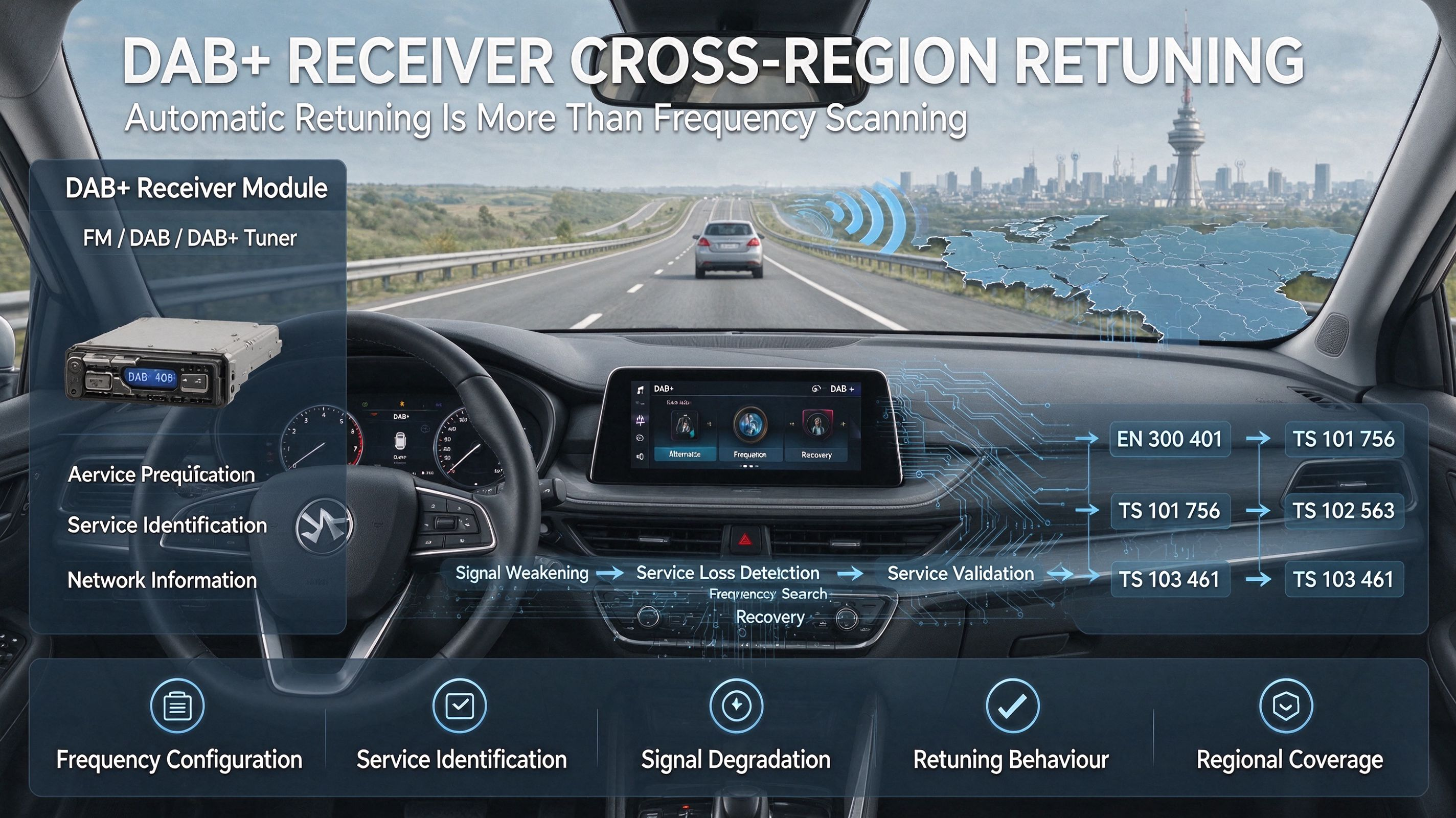
Does Your DAB+ Receiver Know When to Retune? Cross-Region Driving Can Expose Hidden Design Issues.
1. The Challenge of Cross-Region DAB+ Reception
Imagine a vehicle travelling from one country to another.
The driver is listening to a DAB+ radio station. Everything works normally. However, as the vehicle moves beyond the original broadcast coverage area, the reception environment begins to change.
The original signal may become weaker. The frequency configuration may differ in the next region. The same programme may be available through another broadcast network, while the receiver may need to identify and select an alternative service.
For automotive radio manufacturers and Tier 1 suppliers, this creates an important engineering question:
How can a DAB+ receiver maintain a reliable listening experience when the vehicle moves across different broadcast regions?
Automatic retuning is an important consideration in receiver design. However, it should not be treated as a simple frequency-scanning function.
A robust receiver needs to deal with changing reception conditions, service information and network configurations.
2. Understanding the DAB+ Technical Framework
The DAB family of standards is maintained through a technical framework that includes several ETSI specifications.
WorldDAB provides an overview of the relevant technical documents and directs users to the ETSI website for access to the standards.
Some important references include:
EN 300 401: DAB system specification.
TS 101 756: Registered tables.
TS 103 176: Rules of implementation.
TS 102 563: DAB+ audio.
TS 103 461: Minimum receiver requirements.
These documents address different aspects of the DAB ecosystem.
For automotive receiver developers, understanding the relationship between system specifications, implementation rules and receiver requirements is an important starting point.
It is also important to distinguish between the technical specifications themselves and individual receiver design decisions.
Not every implementation detail is prescribed by the same document.
3. Why Automatic Retuning Is More Than Frequency Scanning
A receiver that simply scans for another available frequency may not necessarily provide the best listening experience.
In an automotive environment, the receiver needs to consider several related factors.
Signal availability
The receiver needs to identify whether the current service remains available under changing reception conditions.
Service identification
Finding another signal does not automatically mean that the receiver has found the intended programme.
The engineering challenge is to distinguish between available signals and the service the listener expects to receive.
Network information
Broadcast network information can help the receiver understand the relationship between available services and transmission configurations.
Transition behaviour
A receiver's response during signal degradation and service changes can influence the perceived continuity of the listening experience.
These are important areas for engineering teams to consider during product development.
However, the exact retuning strategy should be determined by the applicable technical specifications, supported broadcast configurations and product requirements.
4. What Can Go Wrong During Cross-Region Driving?
Several scenarios deserve attention during development.
Scenario A: The original service becomes unavailable
A vehicle leaves the original coverage area.
The receiver may continue attempting to receive the original service before searching for alternatives.
Engineering teams should examine how the receiver identifies the loss of service and initiates its recovery process.
Scenario B: Similar programmes are available through different networks
Two regions may broadcast related content using different service configurations.
The receiver needs an appropriate service-selection strategy to avoid selecting an unintended programme.
Scenario C: Reception quality changes rapidly
Vehicle movement, terrain, buildings and local signal conditions can influence reception.
A receiver should be evaluated under changing conditions rather than only in a stable laboratory environment.
Scenario D: The receiver performs a new scan
A scan may take time and can affect the user's listening experience.
The implementation should be assessed for scan behaviour, service recovery and the clarity of the resulting user experience.
5. Practical Validation Checklist
The following checklist is intended as an engineering and project-management recommendation, not a statement that every item is an independently mandated regulatory test.
Checkpoint | Why it matters | Recommended action |
|---|---|---|
Frequency configuration | Regional transmission configurations may differ | Verify the supported frequency configurations against the target markets |
Service identification | An available signal may not represent the intended service | Review service identification and selection behaviour |
Signal degradation | Reception conditions change during driving | Evaluate receiver behaviour under controlled signal reduction |
Retuning behaviour | Recovery behaviour affects listening continuity | Record the time and sequence of service recovery |
Regional coverage | Performance may differ between broadcast regions | Test representative regional configurations |
User experience | Repeated interruptions affect usability | Evaluate audio interruption and recovery behaviour |
Software configuration | Different products may use different firmware settings | Maintain traceable configuration records |
6. What Should Automotive Manufacturers Consider?
For automotive manufacturers and Tier 1 suppliers, DAB+ receiver validation should be considered as part of the wider infotainment development process.
A useful project approach includes:
Identify the intended sales markets.
Confirm the relevant DAB/DAB+ technical requirements.
Identify the supported broadcast configurations.
Define the receiver's service-selection strategy.
Establish representative laboratory test conditions.
Evaluate reception behaviour in realistic vehicle scenarios.
Record software versions and test configurations.
Review unresolved issues before product release.
The purpose is not simply to confirm that the receiver can decode DAB+ audio.
It is to understand how the receiver behaves throughout the expected operating environment.
7. Conclusion
Cross-region driving introduces challenges that may not be obvious during basic receiver testing.
For DAB+ receiver manufacturers, automatic retuning should be considered alongside signal reception, service identification, network information and user experience.
A structured validation approach can help engineering teams identify weaknesses earlier and improve confidence in the final product.
At Blue Asia, we support electronic product manufacturers with EMC, RF and wireless testing and global market-access-related services. For automotive electronic projects, the applicable testing scope should be assessed according to the product configuration and target market.
Contact Blue Asia
Email: [email protected]
WhatsApp: +86 17663606879
 ブログ
Does Your DAB+ Receiver Know When to Retune? Cross-Region Driving Can Expose Hidden Design I
記事を読む
 ブログ
Are You Testing Android Auto Too Late? The Desktop Head Unit Can Help Move Validation Earlie
記事を読む
 ブログ
Can Your eCall System Transmit the Right Data? Position, Time and Vehicle Identification Mat
記事を読む
 ブログ
Does Your CarPlay Interface Really Fit the Vehicle? Display and Interaction Need More Than B
記事を読む
 ブログ
Why The Best Compliance Strategy Is To Design Products That Never Need Retesting
記事を読む
 ブログ
Why Automotive Connectivity Certification Is No Longer About One Test—It's About Buildi
記事を読む
関連サービス

 4000259520