
 English
 Français
 Español
 العربية
 繁体中文
 简体中文


CarPlay Testing Standards and Test Items
CarPlay Testing Standards and Test Items
Contact Blue Asia
Email: [email protected]
WhatsApp: +86 176 6360 6879
CarPlay testing involves a series of verification and evaluation procedures for in-vehicle infotainment (IVI) systems equipped with Apple CarPlay functionality. The purpose is to ensure that the system delivers a stable, reliable, and high-quality user experience when connected to an iPhone and operating with CarPlay enabled.
The testing process covers system compatibility, functionality, performance, and user interface behavior to assess whether the infotainment system meets the relevant technical requirements.
CarPlay Testing Standards
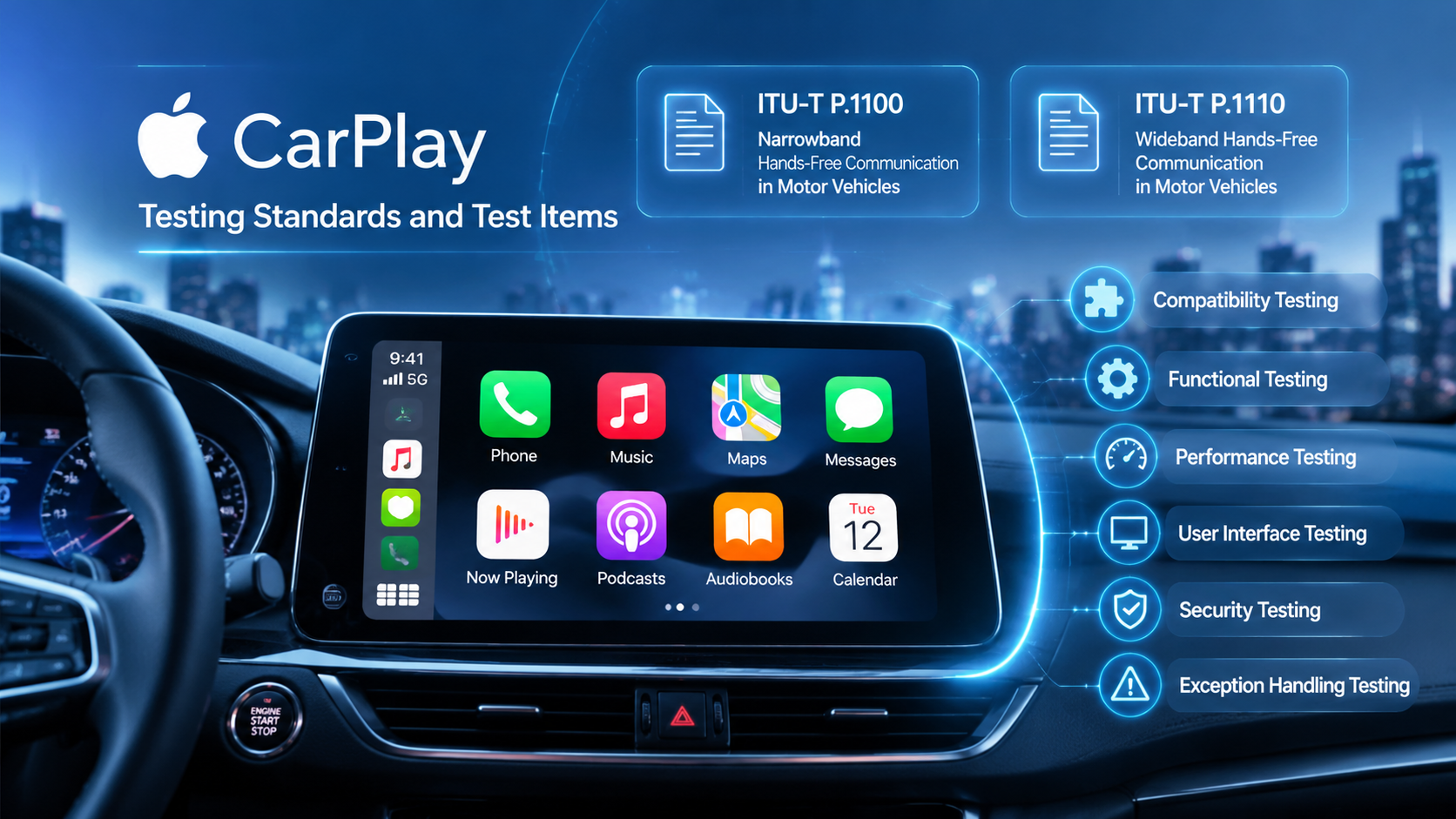
CarPlay-related audio testing primarily references the ITU-T P.1100 and P.1110 recommendations, developed by the International Telecommunication Union (ITU).
These two recommendations address the acoustic performance of hands-free communication systems used in vehicles:
ITU-T P.1100: Narrowband hands-free communication in motor vehicles.
ITU-T P.1110: Wideband hands-free communication in motor vehicles.
Both standards provide technical guidance for evaluating in-vehicle hands-free communication performance and audio quality.
Key CarPlay Testing Items
CarPlay testing may cover several areas to assess the overall functionality and performance of an in-vehicle infotainment system.
1. Compatibility Testing
Verify that the in-vehicle system can establish a stable connection with different iPhone models and correctly initialize CarPlay functionality.
2. Functional Testing
Check whether the main CarPlay functions operate properly, including:
Navigation
Music playback
Phone calls
Voice assistant functionality
3. Performance Testing
Evaluate system response times, operational stability, and overall performance under different operating conditions and usage scenarios.
4. User Interface (UI) Testing
Assess whether the infotainment system's user interface is properly designed, easy to operate, and consistent with the CarPlay interface requirements.
5. Security Testing
Examine potential security risks associated with connecting an iPhone to the in-vehicle system, including possible data leakage and unauthorized access.
6. Exception Handling Testing
Simulate abnormal operating conditions, such as unexpected connection interruptions or low battery levels, to verify whether the system can handle these situations appropriately and recover normal operation.
Why Is CarPlay Testing Important?
A comprehensive testing process helps verify that an in-vehicle infotainment system can deliver a smooth, reliable, and user-friendly experience when integrating Apple CarPlay.
For manufacturers developing or integrating CarPlay-enabled automotive infotainment systems, compatibility, audio performance, functional reliability, and overall system behavior are important considerations during product development and compliance evaluation.
CarPlay-related testing and validation also form part of the preparation for Apple's CarPlay approval process, supporting manufacturers in bringing compatible products to market.
Contact Blue Asia for Automotive Testing and Certification Support
Email: [email protected]
WhatsApp: +86 176 6360 6879
 ブログ
Android Auto Testing Standards and Test Items
記事を読む
 ブログ
CarPlay Testing Standards and Test Items
記事を読む
 ブログ
EU eCall Type Approval: How Long Is It Valid, and When Does It Need to Be Updated?
記事を読む
 ブログ
What Is VCCI Compliance in Japan? Product Scope and Application Process
記事を読む
 ブログ
Canada ISED Certification: Application Process, Standards and Documentation
記事を読む
 ブログ
Does the 2026 DAB+ Standard Update Mean You Need to Retest Your Products?
記事を読む
関連サービス

 4000259520